
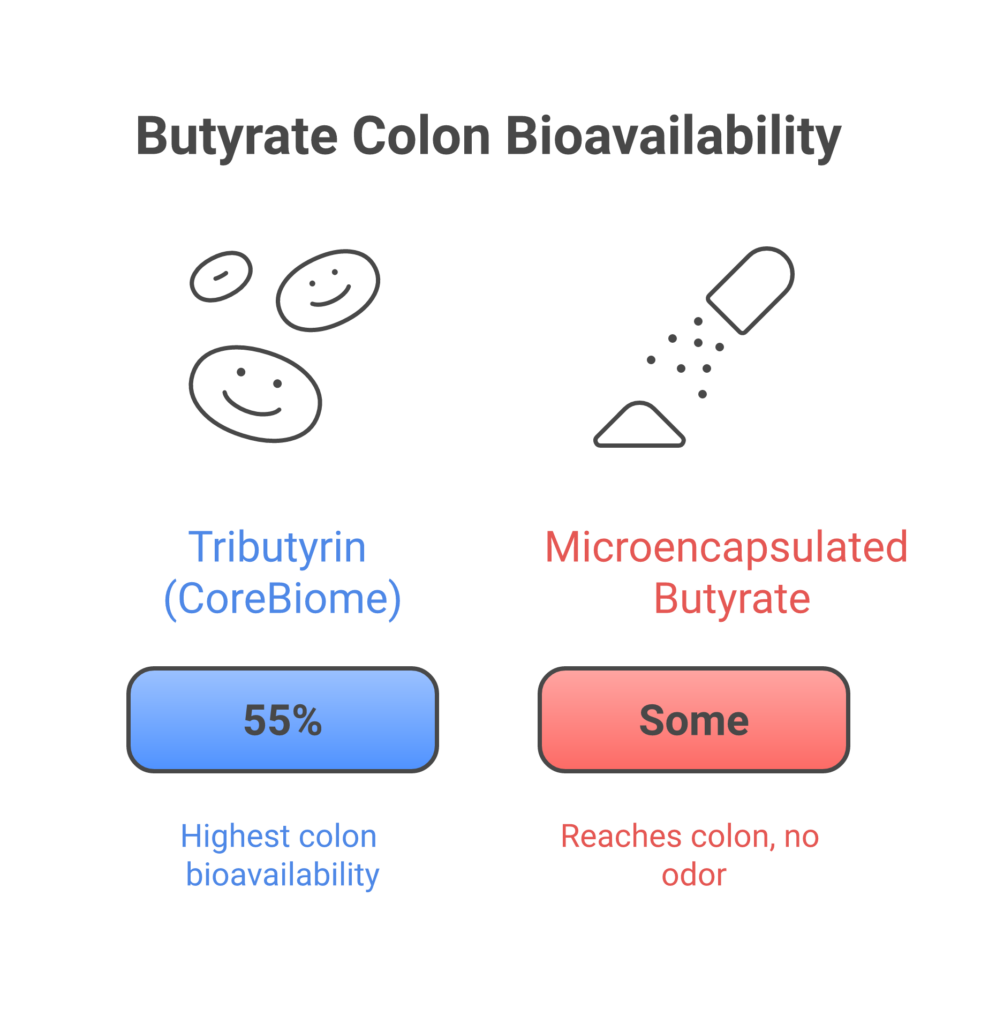
Tributyrin is a triglyceride form of butyrate. Pancreatic lipases split it in the intestine to release butyrate, a fatty acid that colon lining cells use for fuel. When plain butyrate is taken by mouth, most of it is absorbed in the small intestine and relatively little reaches the colon, which is the reason this form exists. CoreBiome is a patented tributyrin ingredient. In a 2025 laboratory study that used a simulated human digestive tract (an in vitro model, not a human trial), 51 to 59% of the CoreBiome dose stayed intact through the simulated upper gut. Lab-model results like this do not tell you how much a person absorbs or whether they will feel a benefit.
Written by the Editorial Team. Medically reviewed by Matthew Olesiak, MD, on September 24, 2026. Last updated March 19, 2026. Part of the Consumer Health Guide research library.
This guide explains what tributyrin is, how it compares to every other butyrate delivery method on the market, what the research actually shows, labeled by type (lab model, animal, or human), and who benefits most from supplementation.
What Is Tributyrin? The Science Behind This Butyrate Prodrug
Tributyrin is a short-chain triglyceride: one glycerol molecule bonded to three butyric acid molecules. When you take tributyrin orally, pancreatic lipases (enzymes in your small intestine) cleave the butyrate molecules from the glycerol backbone.
Tributyrin acts as a prodrug: the butyrate is released only after lipases split the molecule. A 2025 laboratory study in Frontiers in Nutrition (Duysburgh and colleagues, funded by CoreBiome maker Compound Solutions) simulated upper digestion in vitro and found that 59.1% of the tributyrin dose from capsules and 51.3% from softgels remained stable and available to enter the colon. This was a lab model, not a study in people.
Why Butyrate Matters: The Primary Fuel for Your Colon Cells
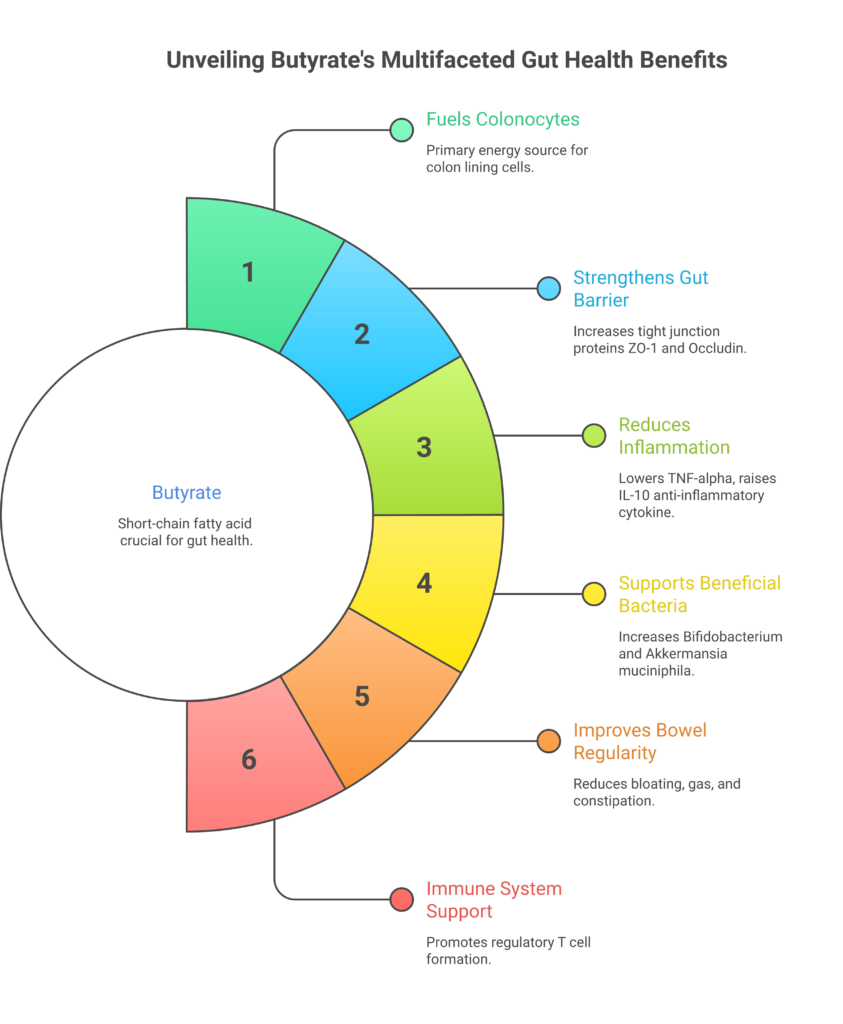
Butyrate is a short-chain fatty acid (SCFA) produced when beneficial gut bacteria ferment dietary fiber. It is the preferred energy source for colonocytes, the cells that line your large intestine. Without adequate butyrate, those cells weaken, the gut barrier becomes permeable (often called “leaky gut”), and inflammatory molecules escape into the bloodstream.
Gut health also influences your skin through what researchers call the gut-skin axis. Learn which topical ingredients complement an inside-out approach in our dark spot remover ingredients. (see gut microbiome research) (see probiotic safety)
Your gut and brain are connected through the vagus nerve and the gut-brain axis. If you are also experiencing nerve discomfort, see our nerve supplement guide for ingredients backed by clinical research.
Here is what butyrate does at the cellular level, based on published research. Most of it comes from lab and animal studies:
- Fuels colonocytes: Short-chain fatty acids, of which butyrate is one, provide an estimated 60 to 70% of the energy needs of colon lining cells, according to a 2023 review in Nutrients.
- Tightens the gut barrier (mouse study): A 2023 study in PLOS ONE found that tributyrin raised the tight junction proteins ZO-1 and Occludin and the mucus protein MUC2 in the intestines of antibiotic-treated mice.
- Inflammatory markers (lab model): In the 2025 Frontiers in Nutrition study, fluid from tributyrin-supplemented gut simulations raised IL-10 (an anti-inflammatory signal) and lowered TNF-alpha (a pro-inflammatory signal) in cultured cells.
- Bacteria (lab model): The same in vitro study reported enrichment of Bifidobacterium longum, Bacteroides fragilis, and Akkermansia muciniphila after three weeks of tributyrin dosing in gut simulations seeded with stool from three healthy donors.
- Regulatory T cells (mouse and lab studies): A 2013 Nature study by Furusawa and colleagues found that butyrate induced colonic regulatory T cells in mice.
Gut bacteria make butyrate when they ferment dietary fiber, so the fiber in your diet is the main natural source of colon butyrate.
Butyrate Supplement Forms Compared: Tributyrin vs Sodium Butyrate vs Calcium Butyrate vs Microencapsulated
There are four main ways supplement companies deliver butyrate. They differ in chemical form and in how much published data exists on where the butyrate ends up.
Sodium Butyrate
Sodium butyrate is a salt that dissolves in water. When butyrate is taken by mouth in this kind of form, most of it is absorbed in the small intestine and relatively little reaches the colon, according to the authors of the 2025 Frontiers in Nutrition study.
Calcium and Calcium-Magnesium Butyrate
Mineral-buffered butyrate forms use calcium or a calcium-magnesium blend in place of sodium. They are still butyrate salts, so the same absorption pattern applies unless the manufacturer adds an enteric coating or microencapsulation layer.
Microencapsulated Butyrate
Some manufacturers coat sodium butyrate or calcium butyrate in a fat or polymer shell designed to survive stomach acid and dissolve in the small intestine. This is an improvement over uncoated forms, but the release location is still primarily the small intestine, not the colon. The coating quality varies between manufacturers, and there is limited published data on how much butyrate actually reaches the colon with most microencapsulated products.
Tributyrin (CoreBiome)
Tributyrin is structurally different from the other forms. Instead of a salt, it is a triglyceride. This means it does not dissolve in stomach acid. It requires pancreatic lipases to release its butyrate. In the 2025 Frontiers in Nutrition lab model, 51 to 59% of CoreBiome tributyrin stayed intact through simulated upper digestion, and tributyrin added to the simulated colon raised butyrate levels in both the proximal and distal colon compartments. The study did not test sodium or calcium butyrate side by side, and the authors say human studies are needed to confirm the findings.
Head-to-Head Summary
| Feature | Sodium Butyrate | Ca/Mg Butyrate | Microencapsulated | Tributyrin (CoreBiome) |
|---|---|---|---|---|
| Chemical form | Salt | Mineral salt | Coated salt | Triglyceride |
| How butyrate is released | Dissolves | Dissolves | Coating breaks down | Split by lipases |
| Colon delivery data we found | None | None | Limited | 2025 lab model: 51 to 59% intact after simulated upper digestion |
| Human trials of colon delivery | None found | None found | None found | None found |
CoreBiome: What Makes This Patented Tributyrin Different
CoreBiome is a patented tributyrin ingredient sold by Compound Solutions. Here is what has been published or stated about it:
- Published lab-model data (2025): The Triple-L-SHIME study in Frontiers in Nutrition tested CoreBiome specifically. In this in vitro gut simulation, three weeks of daily tributyrin dosing increased butyrate levels in both proximal and distal colon compartments for all three donor samples.
- Microbiome changes (lab model): The same study reported enrichment of Bifidobacterium longum, Bacteroides fragilis, and Akkermansia muciniphila in the simulated colon.
- Cell culture data: Fluid from the tributyrin-supplemented simulations protected cultured gut cells against inflammation-induced barrier disruption, with increased IL-10 and decreased TNF-alpha.
- Manufacturer statements: Compound Solutions describes CoreBiome as GRAS by independent conclusion (a self-affirmed determination, not an FDA notification), vegan, made in the USA from fermented sources, and available for capsules, liquid capsules, and softgels.
To be clear about the evidence level: the SHIME study is an in vitro model, not a human clinical trial, and it was funded by Compound Solutions. Its authors describe the results as complementary to clinical trials and say studies in people are needed to confirm them. Lab survival percentages should not be read as the amount a person absorbs or as proof of a health benefit.

Dosage: What the Studies Used
There is no established recommended dose of tributyrin for people. The 2025 CoreBiome lab study modeled a target intake of 300 mg per day, but that was a simulation, not a dose tested in people. Follow the product label and ask your clinician before going above it.
In the 2023 mouse study on antibiotic-induced intestinal damage, the lower of two tributyrin doses did more to restore gut bacteria (including Muribaculaceae and Bifidobacterium) than the higher dose. Mouse doses do not translate directly to people, but the finding is a reminder that more is not automatically better.
Pancreatic lipases are the enzymes that release butyrate from tributyrin, so many labels suggest taking it with a meal.
Who Benefits Most from Tributyrin Supplementation?
Tributyrin is not a universal supplement. These are the groups the research so far points toward, with the type of evidence noted:
- People recovering from antibiotics (mouse evidence): In the 2023 PLOS ONE study, 11 days of tributyrin after an antibiotic course reduced intestinal damage, raised tight junction proteins, and increased beneficial bacteria in mice. This has not been confirmed in people.
- Those with digestive symptoms: In a 2025 randomized, double-blind, placebo-controlled trial in Nutraceuticals, 596 adults were assigned to 200 mg a day of ButyraGen (a branded butyrate-generating ingredient) or placebo for six weeks. The active group reported greater improvement in belly pain than placebo. That product is not CoreBiome, and the result may not apply to other tributyrin products. Anyone with IBS or IBD should work with their gastroenterologist.
- People concerned about gut permeability: The tight junction (ZO-1, Occludin) and mucus (MUC2) findings above come from mice and cell models. Human trials showing that tributyrin reduces gut permeability are still lacking in the studies we reviewed.
- Low-fiber diets: Gut bacteria make butyrate from fiber, so eating more fiber is the first step. If you use a tributyrin supplement, treat it as an addition while you work on increasing fiber from whole foods like high-fiber foods that support gut health.
- Post-antibiotic gut rebuilding: If you are weighing tributyrin against other options after antibiotics, our guide to the postbiotic approach explains how postbiotics, butyrate, and probiotics differ.
Red Flags in Butyrate Supplements: What to Avoid
Not every butyrate product is worth your money. Here are specific warning signs:
- No named ingredient source: If the label just says “butyrate” or “butyric acid” without specifying the form (sodium butyrate, tributyrin, etc.) or the branded ingredient (CoreBiome, ButyraGen, etc.), you have no way to check what you are buying.
- Claims without clinical references: Any supplement claiming “clinically proven” colon delivery should be able to point to a specific published study, and you should check whether that study was in people, animals, or a lab model.
- Excessive proprietary blends: If tributyrin is buried inside a “proprietary gut health blend” with 8 other ingredients and no individual dosing, you cannot tell how much tributyrin you are getting.
- No third-party testing: Look for products with third-party verification from organizations like NSF, USP, or ConsumerLab. Butyrate supplements are not FDA-evaluated for efficacy, so independent testing is your quality safeguard.
For a detailed guide on evaluating postbiotic quality beyond just the butyrate source, see our breakdown of what to look for in a superior postbiotic supplement.
The Bigger Picture: Tributyrin Within a Gut Health Protocol
Tributyrin is not a standalone fix. It works best as part of a broader gut health strategy:
- Diet first: Increase fiber from diverse whole food sources such as vegetables, legumes, whole grains, and fruits. Gut bacteria make butyrate when they ferment fiber.
- Tributyrin supplementation: An optional addition. Human evidence on tributyrin is still early, so treat it as a supplement to diet, not a substitute.
- Use antibiotics only as prescribed: Take antibiotics when your clinician says you need them, and ask before adding any supplement during a course.
- Monitor your response: Track bloating, bowel regularity, and energy levels, and stop and talk to your clinician if symptoms get worse.
For a deeper look at how postbiotics compare to probiotics and prebiotics in a gut health protocol, read our guide on how postbiotics, butyrate, and probiotics compare.
Browse all of our gut health supplements reviews and guides for more product research.
You may also want to read our guide on natural cough remedies.
Researchers are also studying how gut bacteria and their products interact with the nervous system. See our guide on natural support for nerve pain and neuropathy.
Frequently Asked Questions About Tributyrin and CoreBiome
What is the difference between tributyrin and sodium butyrate?
Tributyrin is a triglyceride that needs pancreatic lipases to release its butyrate. Sodium butyrate is a salt, and when butyrate is taken by mouth in this form, most of it is absorbed in the small intestine. In a 2025 lab model (not a human study), 51 to 59% of CoreBiome tributyrin stayed intact through simulated upper digestion. That study did not test sodium butyrate side by side.
How long does it take for tributyrin to work?
There is no established timeline in people. The 2025 CoreBiome study ran its lab gut simulation for three weeks, and the 2023 mouse study used 11 days of tributyrin, but neither measured how people feel. If you try it, track your symptoms and talk to your clinician if nothing changes or symptoms get worse.
Can I take tributyrin with probiotics?
Tributyrin and probiotics are different kinds of products. Probiotics contain live microorganisms, while tributyrin supplies butyrate. Compound Solutions, the maker of CoreBiome, lists it as an ingredient that can be combined with probiotics. Ask your clinician before combining supplements if you have a medical condition.
Is tributyrin safe during pregnancy?
We found no published safety studies of tributyrin supplements during pregnancy or breastfeeding. Consult your OB-GYN or midwife before starting any new supplement during pregnancy.
What is the best time of day to take tributyrin?
Pancreatic lipases are the enzymes that release butyrate from tributyrin, so many labels suggest taking it with a meal. Follow your product label.
Does tributyrin help with weight loss?
No human clinical trials have shown weight loss as a direct outcome of tributyrin supplementation, and it is not a weight loss supplement.
How does CoreBiome compare to ButyraGen?
Both are branded butyrate ingredients. CoreBiome is a tributyrin with a 2025 lab-model study behind it. ButyraGen is a different branded butyrate-generating ingredient, and it was tested in a 2025 six-week randomized, double-blind, placebo-controlled trial that started with 596 adults at 200 mg a day, where the active group reported greater improvement in belly pain than placebo. The two have not been compared head to head.
Are there side effects of tributyrin supplements?
In the 2025 ButyraGen trial, the product was well tolerated and mild side effects were similar to placebo. Safety data for other tributyrin products and higher amounts are limited. If you have a diagnosed digestive condition, work with your doctor before starting.
For side-by-side comparisons of top-rated postbiotic products containing CoreBiome, see our expert postbiotic rankings. You can also browse our complete gut health supplement reviews for additional options.
Further Reading from Consumer Health Guide
If you want to go deeper, our guide to what to take for a stubborn cough covers what most product pages skip. For readers comparing options, see our breakdown of non-stimulant laxative alternatives. A useful companion read is constipation supplement guide.
We also looked closely at nerve regeneration supplement options in a separate guide. For the related question, check when constipation needs medical attention. You can dig into Emma Relief gut supplement breakdown if that overlaps with what you’re researching.
Pair this with natural gut health tips for a fuller picture. Our notes on alpha-lipoic acid and B vitamins for neuropathy address an adjacent topic worth knowing.