

The best vitamins for sciatica and nerve regeneration are B1 (benfotiamine), B6, B12 (methylcobalamin), alpha-lipoic acid (ALA), and acetyl-L-carnitine (ALC). Each of these targets a different part of nerve repair, from rebuilding the myelin sheath to reducing oxidative damage along the nerve pathway. (see peripheral neuropathy)
Medical disclaimer: This article is for informational purposes only and does not replace professional medical advice. Talk to your doctor before starting any supplement, especially if you take prescription medications or have underlying health conditions.
Written by the Editorial Team. Medically reviewed by Matthew Olesiak, MD, on September 24, 2026.
Sciatica pain shoots from your lower back down through the buttock and leg, following the path of the sciatic nerve. Sciatica often gets better on its own, but it commonly comes back, according to MedlinePlus.
So what actually helps nerves heal? The answer is a combination of targeted nutrition, specific supplements backed by clinical trials, and consistent physical rehabilitation. Here’s what the research shows.


What Causes Sciatica (and Why Nerve Health Matters)
Sciatica happens when something presses on or damages the sciatic nerve. Common causes include a slipped or herniated disc, spinal stenosis (narrowing of the spinal canal), spondylolisthesis (vertebral slippage), and piriformis syndrome (a pain disorder involving a narrow muscle in the buttock), according to MedlinePlus.
The compression itself causes pain. But the real damage happens at the cellular level. When a nerve is compressed, blood flow decreases, oxygen supply drops, and inflammatory chemicals flood the area. Over time, the myelin sheath (the protective coating around the nerve fiber) can break down. Signal transmission slows. Numbness, tingling, and weakness follow.
This is where vitamins and supplements enter the picture. They don’t fix a herniated disc. But they can support the biological processes that repair nerve fibers, rebuild myelin, and reduce the inflammatory cascade that keeps the pain cycle going.
B Vitamins: The Foundation of Nerve Repair
A 2021 review in BioMed Research International by Simone Baltrusch described how vitamins B1, B6 and B12 each help protect nerves and support regeneration after injury, with B12 helping to maintain the myelin sheath.
Vitamin B1 (Benfotiamine)
Benfotiamine is a fat-soluble form of thiamine (vitamin B1). In a 2001 study in diabetic rats, Stracke et al. found that benfotiamine nearly normalized nerve conduction after six months and blocked the formation of advanced glycation end-products (AGEs) in nerve tissue, while standard thiamine did not. This was animal research, so it does not show the same effect in people.
Vitamin B6 (Pyridoxine)
B6 is involved in nerve signaling. In a 2009 laboratory study, Yang et al. found that pyridoxine reduced glutamate release from rat brain nerve terminals by lowering calcium entry and protein kinase C activity.
Clinical data from carpal tunnel syndrome patients showed that B6 treatment increased sensory nerve conduction velocity. Vitamin B6 supplements can themselves cause peripheral neuropathy. The U.S. upper limit for adults is 100 mg a day from food and supplements combined (NIH Office of Dietary Supplements), and Australia’s medicines regulator says the risk cannot be ruled out even below 50 mg a day (TGA).
Vitamin B12 (Methylcobalamin)
Much of the research on B12 and nerve regeneration comes from animal studies, so the results below show biological effects rather than proven outcomes in people.
In mice with sciatic nerve crush injuries, Gan et al. (2014) found that mecobalamin (methylcobalamin) improved functional recovery and thickened the myelin sheath. Tamaddonfard et al. (2014) found that B12 sped functional recovery and reduced Wallerian degeneration (the breakdown of nerve fibers after injury) in rats with tibial nerve crush injuries. Watanabe et al. (1994) showed that ultra-high dose methylcobalamin sped nerve regeneration in rats with acrylamide neuropathy.
Supplements often use cyanocobalamin. The body converts it into the active forms, methylcobalamin and 5-deoxyadenosylcobalamin, according to the NIH Office of Dietary Supplements.
If you’re evaluating a nerve supplement, check the label for the amount of each ingredient and ask your doctor or pharmacist whether it fits your situation.
Folate (Vitamin B9)
Folate works with B12 to reduce homocysteine, an amino acid that at elevated levels is toxic to nerve cells. It also supports DNA repair in damaged neurons.
Alpha-Lipoic Acid (ALA): The Antioxidant Nerve Protector
Alpha-lipoic acid is both water-soluble and fat-soluble, which means it can cross the blood-nerve barrier and work directly inside nerve cells. Its primary role is as an antioxidant, neutralizing the reactive oxygen species that accumulate in compressed or inflamed nerves.
A 2023 prospective observational study by Scaturro et al. in Medicina followed 128 young patients with sciatica caused by herniated discs. Those who combined rehabilitation with a supplement mix of ALA, acetyl-L-carnitine, resveratrol and vitamin D had better pain scores than those who had rehabilitation alone or supplements alone. It was not a randomized trial, and the mix makes it impossible to credit ALA on its own.
Acetyl-L-Carnitine (ALC): Nerve Fiber Regeneration Research
Acetyl-L-carnitine is one of the few supplements where trials have looked for nerve regeneration directly, using nerve biopsies.
Sima, Calvani, Mehra, and Amato published an analysis in Diabetes Care (2005) combining data from two 52-week randomized, placebo-controlled trials with 1,257 patients with diabetic neuropathy. ALC produced significant improvements in sural nerve fiber numbers and regenerating nerve fiber clusters, and improved vibration perception. Pain improved significantly in one study and in the combined group on the higher dose.
A 2019 Cochrane review of ALC for diabetic neuropathy rated the evidence on pain relief as very low certainty, so these results still need confirmation.
PEA (Palmitoylethanolamide): The Pain Reducer
PEA (palmitoylethanolamide) is a naturally occurring fatty acid amide.
The largest sciatica-specific trial is a three-week, double-blind, placebo-controlled study by Guida et al. (2010) in 636 patients with low back pain and sciatica, which tested two doses of PEA against placebo. A 2019 reanalysis of the original data in CNS & Neurological Disorders Drug Targets (PubMed Central) calculated a number needed to treat of 1.7 for at least 50% pain relief with the higher dose. Independent confirmation in more trials is still needed.
A 2023 systematic review and meta-analysis in Nutrients (11 double-blind trials, 774 patients) found that PEA reduced chronic pain scores compared with control treatments, and no major side effects were attributed to PEA in any of the studies.
If you are dealing with active sciatic pain, ask your doctor whether PEA is appropriate for you. For more background on supplement safety, see our guide on whether nerve supplements are safe.
Vitamin D3: The Overlooked Nerve Nutrient
In a 2017 study of 145 patients with chronic low back and leg pain (Acta Orthopaedica et Traumatologica Turcica), 22.8% had vitamin D deficiency and another 42.8% had insufficiency. However, the study found no significant link between vitamin D level and pain scores, although people with deficiency had lower functional capacity.
A blood test for 25-hydroxyvitamin D is the main measure of vitamin D status, according to the NIH Office of Dietary Supplements. If your level is low, your doctor can advise on how to correct it.
Curcumin: Anti-Inflammatory Support
Curcumin is the active compound in turmeric. It is poorly absorbed on its own; in a 1998 study in Planta Medica, taking it with piperine from black pepper raised its bioavailability by 2,000% in human volunteers.
Human evidence for curcumin in nerve pain is limited: a 2025 randomized trial of nanocurcumin in people with type 2 diabetes and neuropathy found no improvement in pain compared with placebo.
How Nerve Regeneration Actually Works
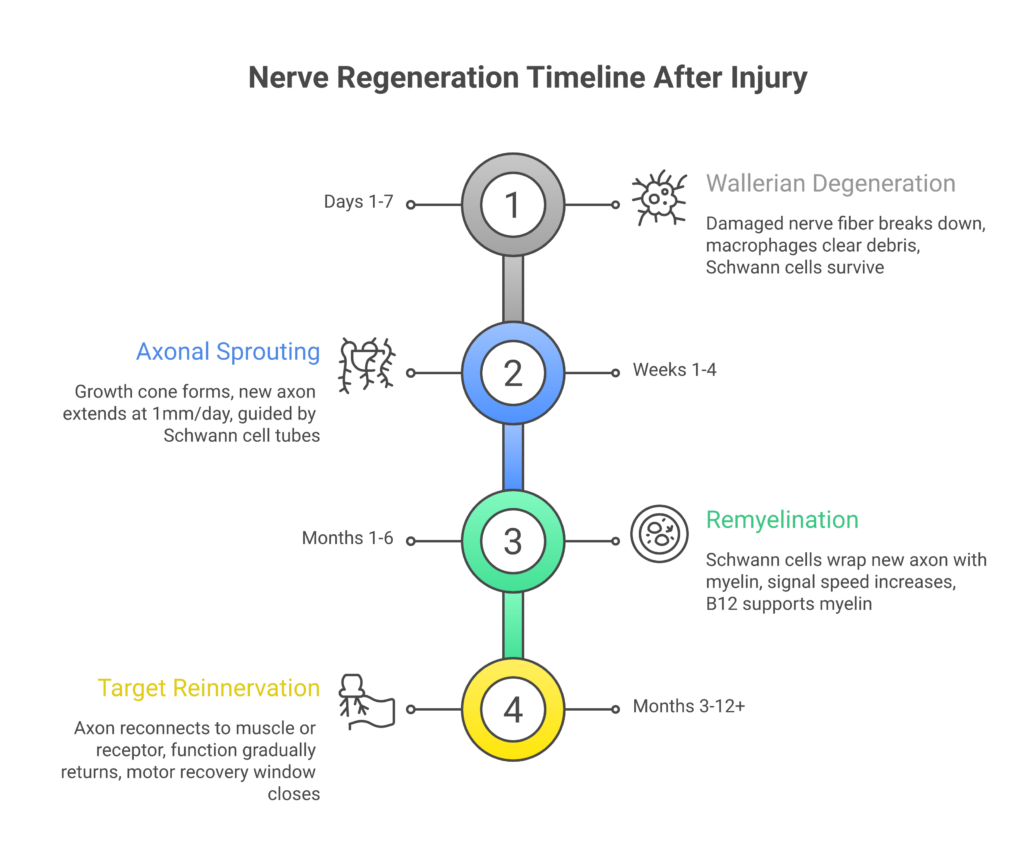
Understanding the biology helps you set realistic expectations. After a nerve is damaged, recovery happens in four phases.
Phase 1, Wallerian degeneration: The damaged nerve fiber breaks down beyond the point of injury. Macrophages move in to clear debris. Schwann cells (the cells that produce myelin) survive and form a tube-like pathway for the regrowing nerve.
Phase 2, axonal sprouting: A growth cone forms at the tip of the surviving nerve stump, and the new axon extends through the Schwann cell pathway.
Phase 3, remyelination: Schwann cells begin wrapping the new axon with myelin. Signal speed gradually increases.
Phase 4, target reinnervation: The axon reaches its target muscle or sensory receptor and forms a new connection.
Most of the supplement research on these stages comes from animal studies, so it is not yet clear how much any supplement speeds recovery in people.
Lifestyle Factors That Help Nerves Heal
Supplements alone won’t fix sciatica. They work best alongside these evidence-based strategies.
Physical Therapy and Targeted Stretching
A physical therapist can identify which movements help and which ones aggravate your specific nerve compression pattern.
Anti-Inflammatory Diet
Omega-3 fatty acids (from fatty fish or flaxseed) reduce systemic inflammation. Colorful vegetables provide polyphenols that protect nerve tissue. Processed foods, excess sugar, and seed oils promote inflammation. You don’t need a perfect diet, but shifting toward whole foods makes a measurable difference in inflammatory markers.
For more on how food choices affect nerve function, read our article on what foods are good for overactive nerves.
Walking
It sounds too simple. But regular walking increases blood flow to the nerve roots, promotes endorphin release, and prevents the deconditioning that makes chronic pain worse. Start with what you can tolerate (even 5 minutes), and build gradually to 30 minutes per day.
Sleep Quality
If pain disrupts your sleep, raise it with your doctor early.
When Surgery Is Needed
Surgery is usually considered only when conservative treatment has not worked or when nerve problems are getting worse. Your doctor or a spine specialist can explain whether it applies to you.
Putting It All Together
This guide does not give supplement doses, and none of these products is a treatment plan for sciatica. The right choice depends on your diagnosis, your blood work, your kidney function and the medicines you already take, so decide with your doctor or pharmacist.
If you use more than one product, add up the vitamin B6 in all of them. Australia’s TGA notes that B vitamins, multivitamins, and magnesium and zinc products can all contain B6, and it is easy to take more than you realize.
To find a quality product that includes many of these ingredients, see our verified nerve supplement reviews.
What to Expect: Realistic Timelines
Nerve regeneration is slow. Trial lengths give a rough idea of how long researchers waited before measuring results:
- 3 weeks: the Guida PEA trial in sciatica
- 30 days of treatment, then follow-up 60 days later: the Scaturro sciatica study
- 52 weeks: the two acetyl-L-carnitine trials analyzed by Sima et al.
None of these timelines guarantees results. Agree with your doctor how long to try a supplement and what change would count as a benefit.
For help choosing the right product, check our guide on what to look for in a nerve supplement, and browse our independent nerve supplement reviews.
For detailed product comparisons, see our nerve health supplement reviews.
You may also want to read our guide on vitamins for eye health.
If you are also interested in eye health, our guide on B vitamins and antioxidants for vision covers the overlapping nutrient set.
Frequently Asked Questions
What is the best vitamin for sciatic nerve pain?
No vitamin has been proven to treat sciatica. Most of the research on B vitamins and nerve regeneration, including B12, comes from animal studies, such as a 2014 mouse study in which methylcobalamin thickened the myelin sheath after sciatic nerve injury (Gan et al., 2014). A 2021 review in BioMed Research International describes how B1, B6 and B12 each support nerve repair.
Can damaged nerves actually regenerate?
Yes, peripheral nerves can regenerate, though the process is slow. Schwann cells form a pathway that guides regrowth, and remyelination follows. In the Sima et al. (2005) analysis in Diabetes Care, acetyl-L-carnitine improved nerve fiber regeneration measured by nerve biopsy in people with diabetic neuropathy.
How long does it take for sciatica to heal with supplements?
There is no reliable timeline. The trials in this guide ran from three weeks (the Guida PEA trial) to 52 weeks (the acetyl-L-carnitine trials). Sciatica often gets better on its own, so ask your doctor how long to try any supplement.
Are nerve supplements safe to take long-term?
Long-term safety data for these supplements are limited. The main caution is vitamin B6. Vitamin B6 supplements can themselves cause peripheral neuropathy. The U.S. upper limit for adults is 100 mg a day from food and supplements combined, and Australia’s medicines regulator (TGA) says the risk cannot be ruled out even below 50 mg a day. A 2023 meta-analysis found no major side effects attributed to PEA in the trials it reviewed. Always tell your doctor what supplements you take, especially if you’re on blood thinners or diabetes medications. Learn more in our nerve supplement safety guide.
Does vitamin D help with sciatica?
A 2017 study of 145 people with chronic low back and leg pain found that about 65% had deficient or insufficient vitamin D levels, but vitamin D level was not significantly linked to pain scores. Vitamin D alone is unlikely to resolve sciatica. Ask your doctor whether a vitamin D test makes sense for you.
What is the difference between benfotiamine and regular vitamin B1?
Benfotiamine is a fat-soluble form of vitamin B1. In a 2001 study in diabetic rats, Stracke et al. found that benfotiamine blocked the formation of advanced glycation end-products (AGEs) in nerve tissue and nearly normalized nerve conduction, while standard thiamine did not. Evidence in people is more limited.
Should I take all these supplements together?
Not without your doctor. Some studies have tested combinations. In diabetic rats, Jolivalt et al. (2009) found that a combination of B1, B6 and B12 reduced pain behaviors and improved sensory nerve conduction. In people, the observational Scaturro et al. (2023) study found that rehabilitation plus a mix of ALA, acetyl-L-carnitine, resveratrol and vitamin D gave better pain scores than either alone. Those were research settings, not a plan to copy at home. Combining products also makes it easier to take too much vitamin B6, so review the full list with your doctor or pharmacist first.
For more resources on nerve health, visit our nerve supplement category, read about foods that support nerve health, or learn more about our review process.
Further Reading from Consumer Health Guide
If you want to go deeper, our guide to lutein and zeaxanthin for eyes covers what most product pages skip. For readers comparing options, see our breakdown of neuropathy supplements.