
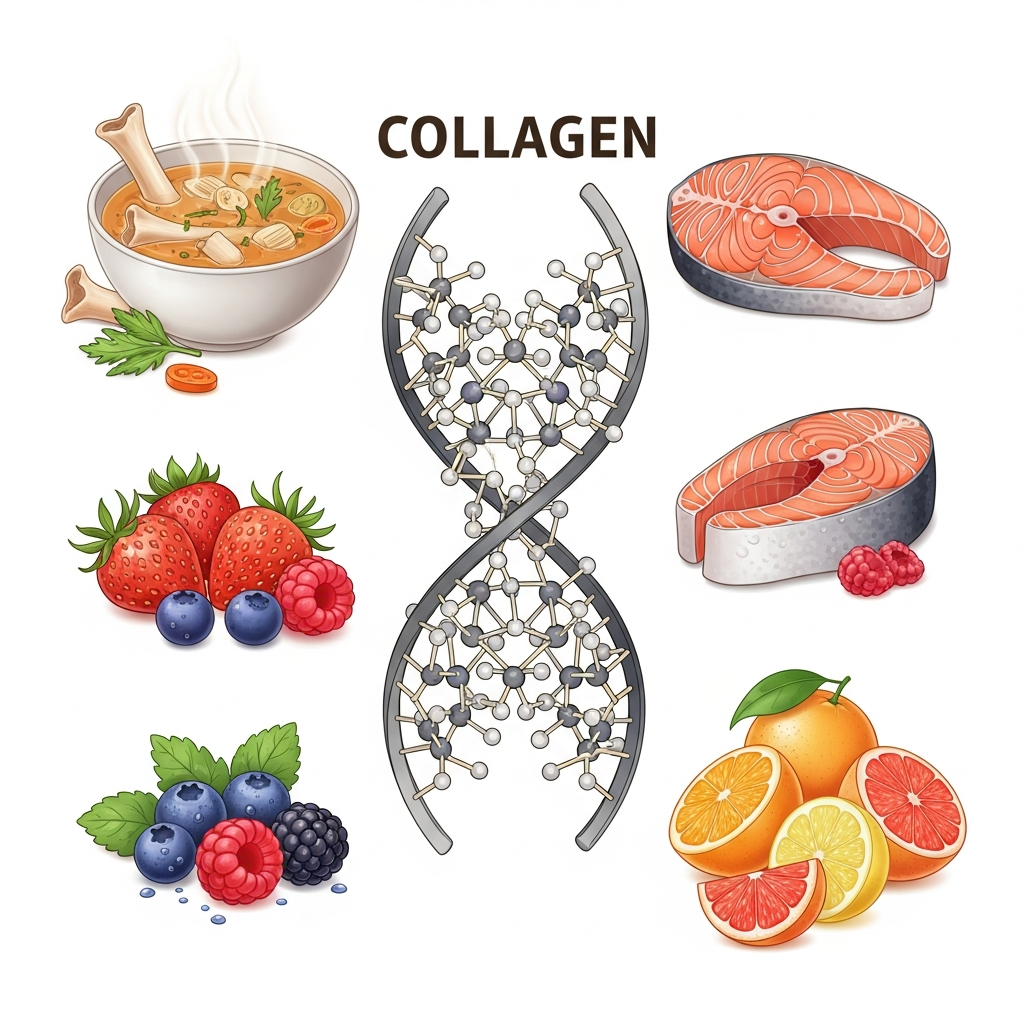
Collagen is the most abundant protein in the human body and the structural foundation of skin, joints, bones, hair, and connective tissue. Production declines with age, and women see a significant drop after menopause (Cleveland Clinic). Vitamin C plays a direct role in collagen synthesis, and sun exposure and smoking both break collagen down. In a 2023 meta-analysis of 26 randomized trials, hydrolyzed collagen supplements improved skin hydration and elasticity compared with placebo. This guide explains the types, food sources, and supplement options.
Medically reviewed by Matthew Olesiak, MD, on September 24, 2026.
This article is for informational purposes only and does not constitute medical advice. Always consult a qualified healthcare provider before starting any supplement regimen.
Collagen is the most abundant protein in your body, making up roughly 30% of your total protein content. It acts as the structural scaffolding for your skin, bones, tendons, ligaments, and cartilage. If you’ve ever wondered what keeps your skin firm, your joints cushioned, or your bones resilient, collagen is a big part of that answer. According to Cleveland Clinic, collagen provides structure, strength, and support throughout your entire body, from your blood vessels to your intestinal lining. (see collagen supplementation research) (see collagen supplement evidence)
Collagen has devoted fans and firm skeptics. The truth sits somewhere in the middle. The science behind collagen is real, but the marketing around it often stretches well beyond what clinical evidence actually supports. In this guide, I’ll walk you through what collagen does, where it comes from, what destroys it, and what you can realistically do to protect and rebuild it.
If you’re here because you want to find a collagen supplement that actually works, check out our verified collagen supplement reviews after reading this guide. Understanding the science first will help you make a smarter purchase.
What Exactly Is Collagen? The Science Behind the Protein
Collagen is a structural protein made up of amino acids, primarily glycine, proline, and hydroxyproline. These amino acids form a triple-helix structure that gives collagen its tensile strength. Think of it like a braided rope at the molecular level.
Your body produces collagen naturally through a process called collagen synthesis. Fibroblast cells (found in your skin and connective tissues) assemble amino acids into procollagen molecules, which are then processed into mature collagen fibers. Your body also needs vitamin C, zinc, copper, and manganese to build collagen’s triple helix, according to Cleveland Clinic.
Collagen isn’t a single molecule. Some 28 types have been identified, and Cleveland Clinic lists five main ones.
The Five Major Types of Collagen
- Type I: Makes up 90% of your body’s collagen. It is densely packed and gives structure to skin, bones, tendons, and ligaments (Cleveland Clinic).
- Type II: Found in elastic cartilage, which provides joint support (Cleveland Clinic).
- Type III: Found in muscles, arteries, and organs (Cleveland Clinic).
- Type IV: Forms basement membranes, the thin layers that separate tissues and act as filtration barriers. Your kidneys rely on Type IV collagen to filter blood properly.
- Type V: Found in the cornea of your eyes, certain skin layers, hair, and placental tissue. Less abundant, but essential for those specific structures.
When supplement companies market “multi-collagen” products, they typically include Types I, II, and III. Types IV and V are rarely supplemented directly. For a broader look at how nutrition supports structural health, see our guide on best foods for gut health, since gut integrity also depends on collagen-rich connective tissue.
What Does Collagen Actually Do in Your Body?
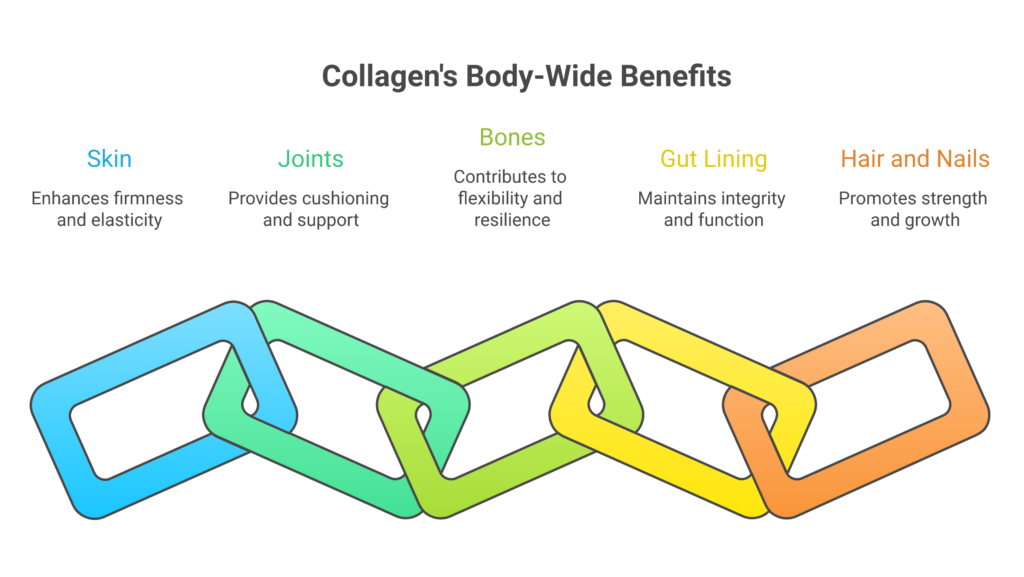
Collagen’s job description is long. Here’s what it handles across your major systems:
Skin Structure and Elasticity
Collagen gives structure, strength, and elasticity to your skin (Cleveland Clinic). In a 2019 randomized, placebo-controlled trial in Nutrients (Bolke et al.), 72 women who drank a supplement with 2.5 g of collagen peptides plus vitamin C, zinc, biotin, and other ingredients for 12 weeks had better skin hydration, elasticity, roughness, and density than the placebo group. Because the drink had several ingredients, the result cannot be credited to collagen alone.
Joint and Cartilage Support
Type II collagen is found in cartilage, which supports your joints (Cleveland Clinic). A 2019 meta-analysis of placebo-controlled trials in International Orthopaedics (Garcia-Coronado et al.) found that collagen supplements lowered total osteoarthritis symptom scores and stiffness, though pain and function subscores did not differ from placebo.
Bone Density
Collagen gives structure to bones (Cleveland Clinic). A 2018 study in Nutrients found that specific collagen peptides increased bone mineral density in postmenopausal women over 12 months (Konig et al., 2018).
Gut Lining Integrity
Evidence that collagen supplements help the gut in people is limited. Most of the research so far is lab work on intestinal cells, not human trials.
Hair and Nail Growth
A 2024 clinical trial published in Dermatology Research and Practice (Reilly et al.) reported better scalp and hair condition, along with skin improvements, after 12 weeks of a supplement containing hydrolyzed collagen.
Why Your Body Makes Less Collagen Over Time
Your body makes less collagen as you age (Cleveland Clinic). Women’s skin loses about 30% of its collagen during the first five years of menopause, according to the American Academy of Dermatology.
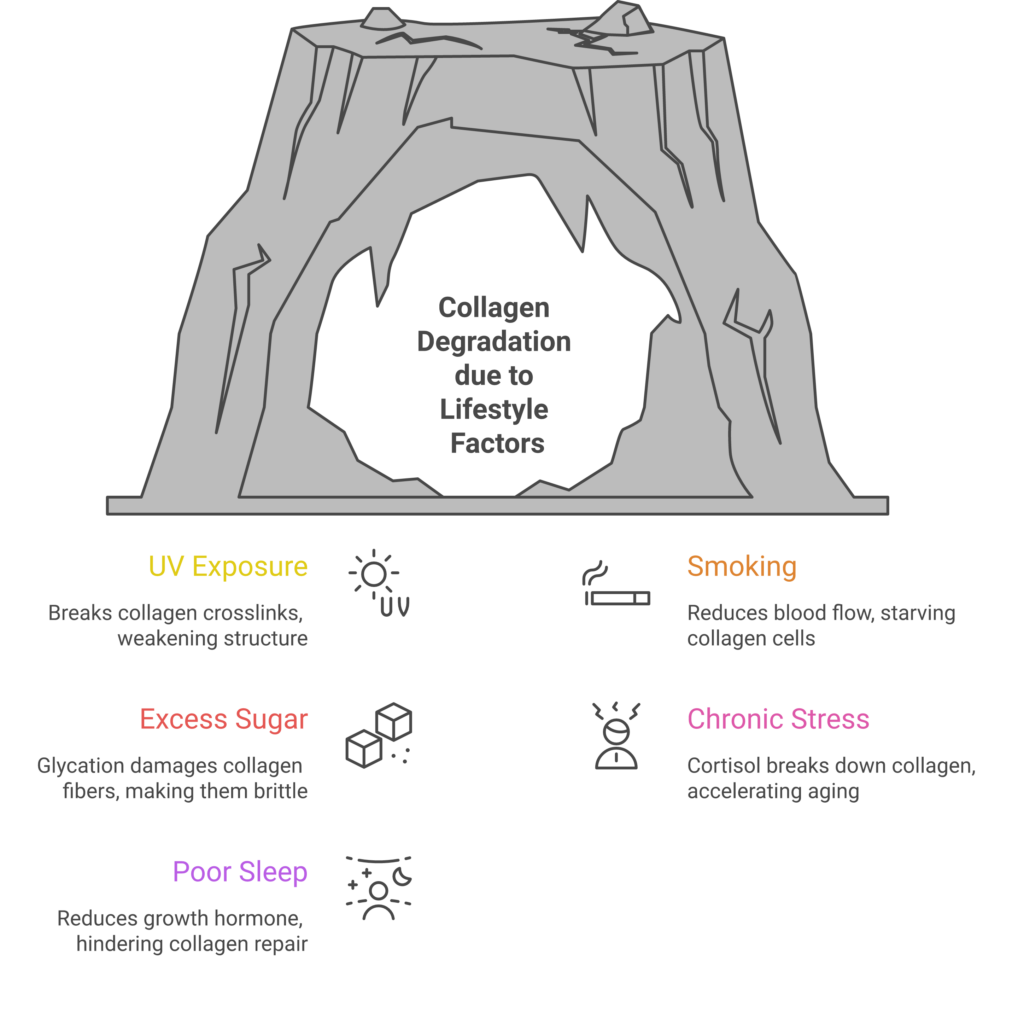
Aging isn’t the only factor. Cleveland Clinic lists smoking, too much sugar, and too much sun as things that damage collagen.
Factors That Destroy Collagen
- UV radiation: Too much sunlight reduces collagen production and makes collagen break down faster (Cleveland Clinic).
- Smoking: Cleveland Clinic lists smoking among the habits that damage collagen, and advises not smoking and avoiding second-hand smoke.
- Excess sugar: Sugar attaches to proteins and forms advanced glycation end products (AGEs), which can make collagen weak, dry, and brittle (Cleveland Clinic).
Understanding these factors matters because even the best collagen supplement reviews won’t help you if you’re actively destroying collagen faster than you can rebuild it.
Dietary Sources of Collagen and Collagen-Boosting Nutrients
You can get collagen directly from food, or you can eat foods that give your body the raw materials to produce its own collagen. Both strategies matter.
Direct Collagen Sources
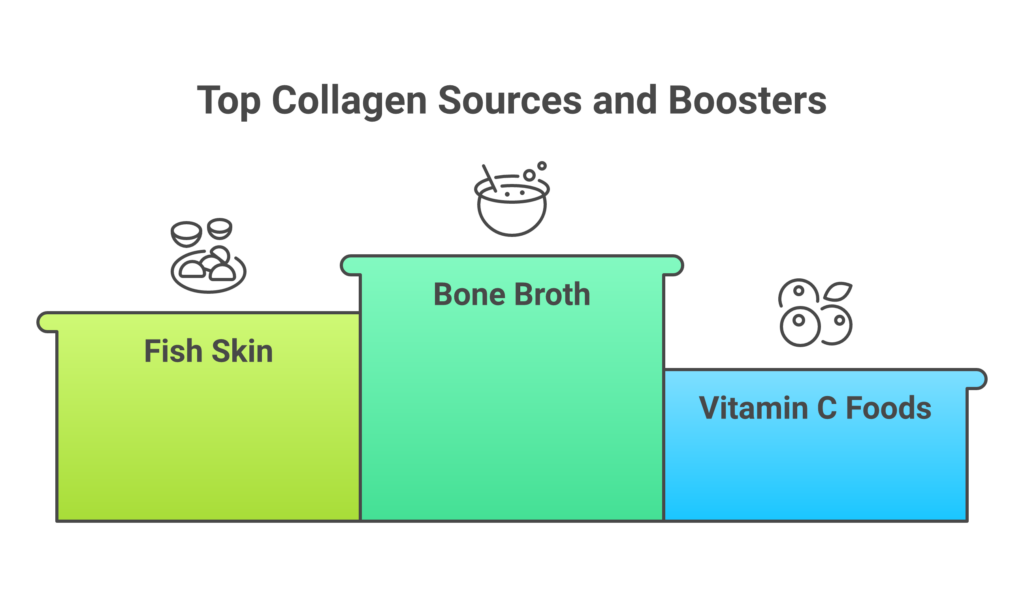
- Bone broth: A 2019 study in the International Journal of Sport Nutrition and Exercise Metabolism (Alcock et al.) found that bone broth made to a standard recipe had lower levels of collagen building blocks than a 20 g dose of a collagen supplement used in research, and that broths made without a set recipe varied widely.
- Fish and shellfish: Cleveland Clinic lists fish among collagen-rich foods.
- Chicken: Chicken skin, cartilage, and connective tissues contain significant collagen. Chicken feet, popular in Asian cuisine, are especially collagen-dense.
- Egg whites: While not a direct collagen source, eggs contain proline, one of the key amino acids your body needs for collagen synthesis.
- Organ meats: Liver, heart, and other organ meats from pasture-raised animals contain collagen along with other supportive nutrients like vitamin A and iron.
Collagen-Boosting Nutrients
Even if you don’t eat collagen directly, these nutrients fuel your body’s own collagen production:
- Vitamin C: Your body needs vitamin C to make collagen. Cleveland Clinic lists oranges, strawberries, bell peppers, broccoli, Brussels sprouts, and potatoes as sources.
- Zinc: Activates proteins required for collagen synthesis. Found in oysters, red meat, chickpeas, pumpkin seeds, and cashews.
- Copper: Required for the enzyme lysyl oxidase, which cross-links collagen fibers for strength. Found in organ meats, shellfish, dark chocolate, and sesame seeds.
- Sulfur: Helps form the disulfide bonds in collagen. Found in garlic, onions, cruciferous vegetables, and eggs.
For more on how food choices affect your body from the inside out, our article on dark spot remover ingredients covers the vitamin C crossover between diet and skincare.
Collagen Skincare Products: Do Topical Treatments Actually Work?
This is where I need to be honest with you. Most collagen skincare products face a fundamental problem: whole collagen molecules are too large to penetrate the outer layer of your skin (the stratum corneum). Applying a collagen cream to your face mainly provides surface-level hydration. It sits on top of your skin and makes it feel smoother temporarily, but the collagen molecules themselves are not reaching the deeper dermis where your body actually builds new collagen.
Skin generally lets through only small molecules, usually under about 500 daltons (Ng, Pharmaceutics, 2018), and whole collagen is a much larger protein. That is why most collagen creams act mainly as surface moisturizers.
What Topical Ingredients Actually Stimulate Collagen?
If you want products with collagen-stimulating effects, look for these ingredients with actual clinical evidence:
- Retinoids (vitamin A derivatives): The American Academy of Dermatology says retinol can increase collagen in your skin.
- Vitamin C serums (L-ascorbic acid): A 2017 review in Nutrients (Pullar et al.) describes vitamin C stimulating collagen synthesis in skin, but notes that how well topical vitamin C works, compared with getting enough in your diet, is poorly understood.
- Peptide serums: The AAD says peptides can increase collagen in your skin.
Bottom line: products with collagen IN them are mostly moisturizers. Products that stimulate your body to MAKE more collagen are the ones worth your money. If you’re exploring anti-aging skincare, our wrinkle cream reviews evaluate which products have ingredients that can actually reach the dermis.
Oral Collagen Supplements: What Does the Research Say?
Here is what the research on oral collagen supplements shows.
How Oral Collagen Gets Absorbed
When you swallow a collagen supplement, your digestive system breaks it down into individual amino acids and small peptides. Hydrolyzed collagen (also called collagen peptides) has already been broken into smaller pieces. A 2017 study in the Journal of Agricultural and Food Chemistry (Yazaki et al.) found collagen-derived peptides in human blood after people took collagen hydrolysate, and in a mouse model those peptides reached the skin.
Clinical Evidence for Skin Benefits
A 2023 systematic review and meta-analysis published in Nutrients (Pu et al.) analyzed 26 randomized controlled trials involving 1,721 participants. The findings were clear: hydrolyzed collagen supplementation significantly improved skin hydration and elasticity compared to placebo. The benefits became statistically significant after 8 weeks of consistent use.
A 2019 randomized, placebo-controlled study (Bolke et al., Nutrients) used a drink with 2.5 g of collagen peptides plus other ingredients and found improvements in skin hydration, elasticity, roughness, and density over 12 weeks.
Evidence for Joint Benefits
A 2019 meta-analysis in International Orthopaedics (Garcia-Coronado et al.) pooled placebo-controlled trials of collagen for osteoarthritis. Collagen lowered total WOMAC scores, stiffness, and pain on a visual scale, but WOMAC pain and function subscores did not differ from placebo.
Choosing a product? Our guide to what to look for in a collagen supplement covers the label checks that matter.
How to Increase Collagen in Your Face: A Practical Guide
This is one of the most-searched questions about collagen, and for good reason. Your face is where collagen loss shows up first and most visibly. Here’s a step-by-step approach based on current evidence.
Step 1: Protect What You Have
Before you try to build more collagen, stop destroying it. That means:
- Wear sunscreen with SPF 30 or higher when you’re outside, as Cleveland Clinic advises.
- Quit smoking or avoid secondhand smoke exposure.
- Reduce sugar intake to limit glycation damage.
Step 2: Feed Your Collagen Machinery
- Eat vitamin C-rich foods daily (bell peppers, citrus, berries, broccoli).
- Include protein-rich foods with proline and glycine (bone broth, chicken, fish, eggs).
- Add zinc and copper sources (pumpkin seeds, shellfish, cashews).
Step 3: Use Evidence-Based Topicals
- Ask a dermatologist whether a retinoid (prescription tretinoin or OTC retinol) suits your skin.
- If you use a vitamin C serum, apply it under sunscreen.
- Consider a peptide-based night cream to complement your retinoid.
Step 4: Consider Oral Supplementation
Skin trials of hydrolyzed collagen have run for 8 weeks or longer (see the research section above). Our collagen supplement guide covers the amounts used in studies and what to look for on a label.
Taking creatine as well? See can you take collagen and creatine together.
Step 5: Explore Professional Treatments (Optional)
- Microneedling: Creates controlled micro-injuries that trigger your body’s wound-healing response, producing new collagen. Talk with a dermatologist about how many sessions you would need.
- Red light therapy: A 2014 controlled study in Photomedicine and Laser Surgery (Wunsch and Matuschka, 136 volunteers) tested red and near-infrared light twice a week and measured fine lines, wrinkles, roughness, and collagen density by ultrasound after 30 sessions, reporting improvements in the treated groups.
- Chemical peels: Medium-depth peels can stimulate collagen remodeling in the dermis.
Collagen Shots and Drinks: Are They Worth It?
Collagen shots and liquid collagen drinks have become popular because they’re convenient and often marketed as delivering faster results than powders or capsules. But does the format actually matter?
From a bioavailability standpoint, liquid collagen and powdered collagen peptides dissolved in water have not been compared head to head in a published trial that we found. The practical difference is usually the amount of collagen per serving, so check the label.
A 2024 clinical trial (Reilly et al., Dermatology Research and Practice) used a liquid collagen supplement and found measurable improvements in skin collagen levels, hydration, elasticity, and wrinkle depth after 12 weeks. The format worked, but there’s no strong evidence that liquid form is superior to powder dissolved in water at the same dose.
What you’re often paying a premium for with collagen shots is convenience and added ingredients like vitamin C, hyaluronic acid, or biotin. If cost matters, a high-quality hydrolyzed collagen powder mixed into water or a smoothie provides the same peptides at a lower price per gram.
The Vitamin C Connection: Why It’s Non-Negotiable
Your body needs vitamin C, along with zinc, copper, and manganese, to form collagen’s triple helix (Cleveland Clinic).
This isn’t a minor detail. When sailors developed scurvy from months without fresh produce, their symptoms (bleeding gums, skin lesions, poor wound healing, joint pain) were all directly caused by collagen synthesis failure due to vitamin C depletion.
If you’re taking a collagen supplement without also getting enough vitamin C, you may be limiting the supplement’s effectiveness. Many high-quality collagen products now include vitamin C for this exact reason.
Common Myths About Collagen
Let me clear up some persistent misconceptions:
Myth: “Collagen creams rebuild collagen in your skin.”
Reality: Most topical collagen molecules are too large to penetrate beyond the surface layer. Skin generally lets through only small molecules, usually under about 500 daltons (Ng, Pharmaceutics, 2018).
Myth: “Vegan collagen supplements exist.”
Reality: Collagen is an animal protein. No plant produces it. “Vegan collagen” products are typically collagen-boosting supplements that contain vitamin C, zinc, and plant amino acids intended to support your body’s own collagen production. They do not contain actual collagen.
Myth: “You can eat enough collagen through food alone.”
Reality: While bone broth and animal connective tissues provide collagen, the amounts are inconsistent and hard to measure. A 2019 study (Alcock et al.) found that bone broth made to a standard recipe had lower levels of collagen building blocks than the supplement doses used in research.
Myth: “All collagen supplements are the same.”
Reality: Source, hydrolysis level, peptide size, dosage, and third-party testing all affect quality and efficacy.
Myth: “Collagen supplements work immediately.”
Reality: The skin trials cited here measured results after 8 weeks or more, and the de Miranda meta-analysis concluded that 90 days of use reduced signs of skin aging.
You may also want to read our guide on vitamins for eye health.
Endogenous collagen synthesis depends partly on gut absorption of the amino acids and cofactors required (vitamin C, copper, glycine). If digestion is sluggish or inflamed, collagen production suffers. Our guide on supporting absorption through gut health covers the digestive side.
Frequently Asked Questions About Collagen
What is collagen and what does it do?
Collagen is a structural protein that makes up about 30% of your body’s total protein. It provides strength and structure to your skin, bones, cartilage, tendons, and ligaments. Your body naturally produces collagen, but production declines with age (Cleveland Clinic).
What are the main advantages of taking collagen supplements?
A 2023 meta-analysis of 26 randomized controlled trials in Nutrients found that hydrolyzed collagen improved skin hydration and elasticity compared with placebo (Pu et al.). In a 12-month trial, 5 grams per day of specific collagen peptides improved bone mineral density in postmenopausal women (König et al., 2018). Results depend on consistency and the quality of the supplement.
How can I increase collagen in my face naturally?
Start by protecting the collagen you have: too much sun and smoking both reduce collagen production, and sugar can weaken collagen (Cleveland Clinic). Eat foods that supply vitamin C and the amino acids proline and glycine, such as citrus, bell peppers, fish, eggs, and meat. Oral hydrolyzed collagen improved skin hydration and elasticity in a 2023 meta-analysis (Pu et al.).
Do collagen skincare products actually work?
Most collagen creams mainly moisturize the skin surface. Whole collagen is a large protein, and skin generally lets through only small molecules, usually under about 500 daltons (Ng, Pharmaceutics, 2018).
What foods are highest in collagen?
Cleveland Clinic notes that your body can’t absorb collagen in its whole form, so it points to foods that supply collagen’s building blocks: vitamin C (oranges, strawberries, bell peppers, broccoli), proline (mushrooms, cabbage, fish, eggs, meat), glycine (red meat, chicken, pork skin, peanuts), copper (liver, oysters, nuts, dark chocolate), and zinc (oysters, red meat, beans, broccoli, whole grains).
Are collagen shots worth the money?
A 2024 trial by Reilly et al. in Dermatology Research and Practice found improvements in skin hydration, elasticity, and wrinkles after 12 weeks of a liquid supplement with 8 grams of hydrolyzed collagen and vitamin C, compared with placebo. Powder delivers the same kind of peptides, often for less money per gram.
Can vegetarians or vegans get collagen benefits?
Collagen itself is an animal-derived protein, so there’s no plant-based collagen. However, vegetarians and vegans can support their body’s own collagen production by consuming adequate vitamin C, zinc, copper, and amino acids from plant sources like soy, legumes, nuts, and seeds. “Vegan collagen” supplements contain these supportive nutrients, not actual collagen molecules.
For a detailed comparison of collagen supplements, visit our verified collagen supplement reviews. We evaluate each product on ingredients, dosage, third-party testing, and value. You can also explore our full collagen supplement category for more in-depth analysis.
Collagen is one of the most important proteins in your body, and understanding how it works gives you real power over your skin health, joint function, and overall aging trajectory. The combination of protective habits, collagen-supportive nutrition, evidence-based topicals, and consistent supplementation is where the science points. Start with the basics, stay consistent, and let the evidence guide your decisions.
For more science-backed health guidance, explore Consumer Health Guide and learn about our review methodology.
Further Reading from Consumer Health Guide
If you want to go deeper, our guide to anti-aging skincare for men covers what most product pages skip. For readers comparing options, see our breakdown of anti-wrinkle creams that actually work. A useful companion read is what to look for in a collagen supplement.
We also looked closely at skincare for women over 50 in a separate guide. For the related question, check neck wrinkle treatments. You can dig into how to remove fine lines if that overlaps with what you’re researching.
Pair this with comparing collagen formats for a fuller picture. Our notes on retinol for wrinkles address an adjacent topic worth knowing.