
The best anti-wrinkle creams pair an ingredient that can build collagen, such as retinol or peptides, with daily broad-spectrum sunscreen. According to the American Academy of Dermatology, retinol and peptides can increase collagen in the skin, and sun protection can reduce visible wrinkles and prevent new ones. Vitamin C, niacinamide, and hyaluronic acid are covered below.
Written by the Editorial Team. Updated March 2026. Part of the Consumer Health Guide research library. Medically reviewed by Matthew Olesiak, MD, on September 24, 2026.
Finding the best anti-wrinkle cream is not about chasing miracle claims. It is about identifying products with clinically tested ingredients that target real skin aging processes. This guide draws on published clinical trials to help you pick creams that match your specific concerns, whether that is fine lines, deep wrinkles, sagging skin, or overall aging prevention. (see skin aging prevention) (see anti-aging skincare research)
How Anti-Wrinkle Creams Actually Work
Before picking a cream, it helps to understand what causes wrinkles in the first place. Skin aging involves two main processes: intrinsic aging (genetic, time-based) and extrinsic aging (sun damage, pollution, lifestyle). Both reduce collagen production, thin the epidermis, and break down elastin fibers.
Anti-wrinkle creams work through a few mechanisms:
- Boosting collagen synthesis: Retinoids and vitamin C stimulate fibroblasts to produce more collagen types I and III, which form the structural scaffolding of skin.
- Hydration and plumping: Hyaluronic acid holds up to 1,000 times its weight in water, temporarily filling fine lines from the surface.
- Cell turnover: Retinoids accelerate the shedding of damaged surface cells and replacement with healthier ones underneath.
- Antioxidant protection: Vitamin C and niacinamide neutralize free radicals from UV exposure and pollution before they damage collagen.
No cream can replicate the effects of professional treatments like laser resurfacing or injectable fillers. But the right topical products, used consistently, can measurably improve fine lines, skin texture, and firmness over 8 to 12 weeks. A 2006 study in the journal Clinical Interventions in Aging confirmed that retinoids remain the most thoroughly studied topical agents for treating photoaged skin, with clinical improvement visible in as little as 3 to 4 months (Mukherjee et al., 2006, Clinical Interventions in Aging).
The Five Ingredients That Matter Most
1. Retinoids (Retinol, Retinaldehyde, Tretinoin)
Retinoids are the single most studied anti-aging ingredient in dermatology. Dr. Angela Lamb, a dermatologist quoted in Today, calls retinoids “the gold standard” and says the ingredient “boosts cell turnover, smooths wrinkles and improves texture.”
Here is what the clinical data shows. A 1998 study by Pierard-Franchimont et al. demonstrated significant improvement in fine wrinkles after 12 weeks of retinol use. A longer 12-month daily application trial by Green et al. (1993) found significant improvement in clinical signs of photoaging, with major changes appearing after 6 months.
One thing to keep in mind: over-the-counter retinol is about 20 times less potent than prescription tretinoin. That means it is gentler (fewer side effects like peeling and redness) but also slower to show results. Most dermatologists suggest starting with a low concentration (0.25% to 0.5%) and building up over several weeks.
If you have sensitive skin, retinaldehyde offers a middle ground. It converts to retinoic acid in one fewer step than retinol, so it works faster with less irritation for many people.
2. Peptides
Peptides are short chains of amino acids that act as signaling molecules. When applied to skin, certain peptides tell fibroblasts to ramp up collagen production. The most studied include palmitoyl tripeptide-1 (Matrixyl) and acetyl hexapeptide-3 (Argireline).
An 8-week clinical study of 45 women testing a peptide cream with niacinamide and hyaluronic acid showed a 21% decrease in the appearance of wrinkles, a 26% decrease in fine lines, and a 38% improvement in firmness. Sagging in the lower face was reduced by 27% (Lancome clinical data, 2024).
Peptides work well in combination with other actives. They rarely cause irritation, which makes them a solid choice if retinoids are too harsh for your skin.
3. Vitamin C (L-Ascorbic Acid)
Vitamin C is a potent antioxidant that serves double duty: it protects existing collagen from free radical damage and stimulates new collagen formation. Dr. Joshua Zeichner, a dermatologist quoted in Today, notes that vitamin C aids collagen production and blocks abnormal pigmentation.
The clinical evidence is strong. A study published in the journal Experimental Dermatology found that topical 5% ascorbic acid cream applied daily for 6 months increased collagen type I mRNA by 25% and collagen type III mRNA by 21% in postmenopausal women (Humbert et al., 2003). A separate 12-week trial with 23 subjects demonstrated significant wrinkle reduction in the crow’s feet area using vitamin C microneedle patches.
One important detail: vitamin C is unstable. It oxidizes when exposed to light and air, turning yellow-brown and losing effectiveness. Look for products in opaque, airtight packaging. The most effective concentration range in clinical trials is 10% to 20%. Below 8%, the effects are minimal. Above 20%, you get more irritation without proportional benefit.
4. Niacinamide (Vitamin B3)
Niacinamide strengthens the skin barrier, reduces inflammation, and improves uneven skin tone. A 2005 study published in Dermatologic Surgery by Bissett et al. found that 5% niacinamide applied to the face over 12 weeks reduced fine lines, wrinkles, hyperpigmentation, red blotchiness, and sallowness compared to a placebo.
A 2024 study in Scientific Reports tested a combination of niacinamide and hyaluronic acid on 44 women for two months. The treatment improved fine lines, wrinkles, luminosity, smoothness, and plumpness. Tissue analysis showed increased collagen and glycosaminoglycan production.
Niacinamide is well-tolerated by most skin types, including sensitive skin. It also pairs well with nearly every other active ingredient, so you will find it in many combination formulas.
5. Hyaluronic Acid
Hyaluronic acid (HA) is a naturally occurring molecule in skin that decreases with age. Dr. Charisse Dolitsky explains that HA makes “cells plump up, more dewy and hydrated,” which temporarily minimizes fine line appearance.
HA provides immediate visual improvement, but the effects are surface-level. It does not stimulate collagen or repair structural damage. Think of it as a hydration booster that makes other active ingredients work better. Low-molecular-weight HA (under 50 kDa) penetrates deeper into skin, while high-molecular-weight HA sits on the surface and forms a moisture barrier.
For the best results, apply HA to damp skin. It pulls moisture from the environment into your skin, but in very dry climates, it can actually draw moisture out of deeper skin layers if there is no external humidity to absorb.
Best Anti-Wrinkle Creams by Skin Concern
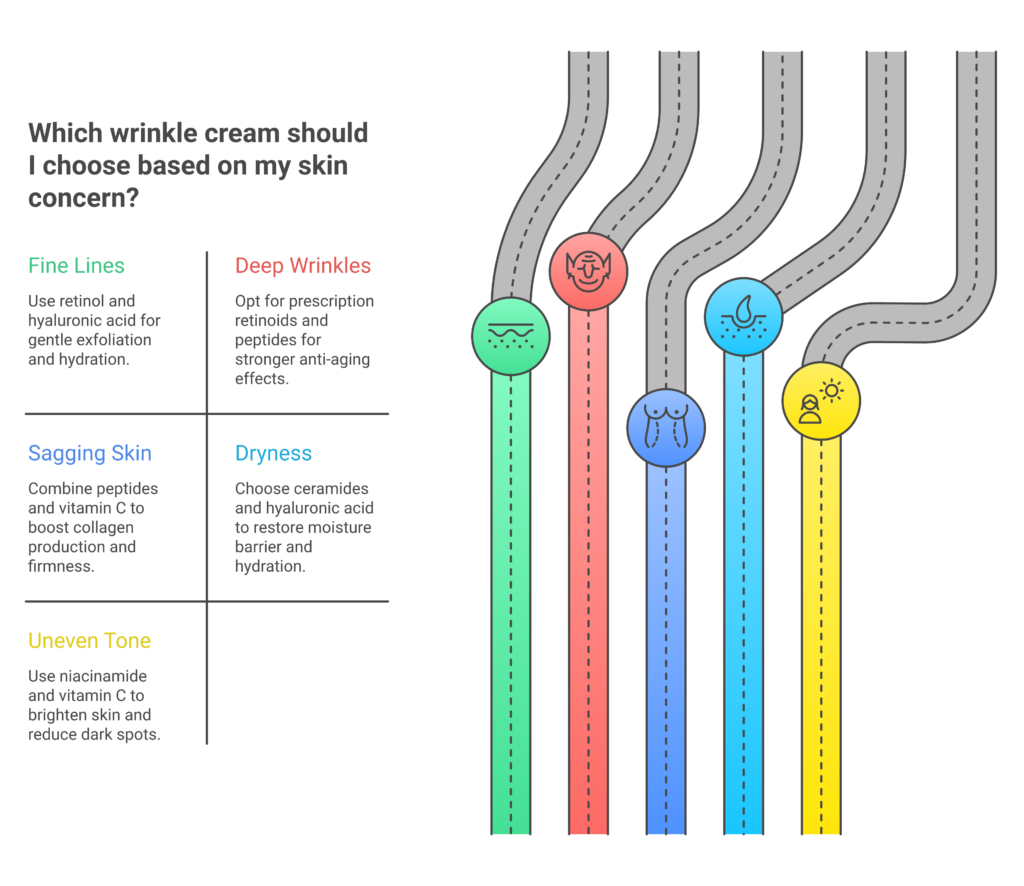
Best for Fine Lines and Early Prevention
CeraVe Skin Renewing Night Cream (around $18 to $22)
This drugstore option contains a peptide complex, hyaluronic acid, and ceramides. CeraVe consistently appears on dermatologist recommendation lists because the ceramide-based formula repairs the skin barrier while the peptides address fine lines. It is fragrance-free and non-comedogenic. For early-stage aging (late 20s through 30s), this is a practical starting point. Learn more about related active ingredients for skin health in our ingredient guide.
Neutrogena Rapid Wrinkle Repair Regenerating Cream (around $22 to $28)
Neutrogena uses Retinol SA, a stabilized retinol form paired with glucose complex and hyaluronic acid. The stabilization means less oxidation over the product’s shelf life. In their clinical testing, visible results appeared in as little as one week for surface-level hydration, with wrinkle improvement developing over 8 to 12 weeks.
Best for Deep Wrinkles and Established Lines
SkinCeuticals A.G.E. Interrupter Advanced (around $182)
This is a higher-investment product backed by serious research. SkinCeuticals developed it from over 15 years of glycation research. The formula features 18% Proxylane along with flavonoids and blueberry extract. Glycation is a process where sugar molecules bind to collagen fibers, making them stiff and less elastic. This cream specifically targets that process. Clinical testing showed smoothing of fine lines and deeper wrinkles, including forehead lines, nasolabial folds, and crow’s feet. If you have pronounced wrinkles and want a targeted treatment, this is one of the most research-backed options available.
RoC Retinol Correxion Max Daily Hydration Cream (around $25 to $30)
RoC has been in the retinol space for decades. This formula combines retinol with hyaluronic acid for both short-term plumping and long-term structural improvement. It is a good mid-range option for people who want retinol benefits without the price tag of professional-grade products. The fragrance-free formula works for dry and sensitive skin types.
Best for Sagging and Loss of Firmness
Olay Regenerist Micro-Sculpting Cream (around $26 to $30)
Olay’s formula combines amino-peptide complex II, niacinamide, and hyaluronic acid. The peptide blend targets firmness and elasticity. In consumer testing, users reported firmer-feeling skin within 2 weeks, though measurable structural changes take closer to 8 to 12 weeks. The lightweight, non-greasy texture makes it suitable for daily use under makeup.
Skinbetter Science AlphaRet Overnight Cream (around $135)
This cream gets frequent mentions from dermatologists because it combines a retinoid with an alpha hydroxy acid (glycolic acid) in a way that minimizes the irritation you would normally get from layering these two actives separately. Dr. Marnie Nussbaum identifies glycolic acid as the smallest AHA molecule, which means it “penetrates the best.” The combination accelerates cell turnover while building collagen. If sagging and texture are your primary concerns, this dual-action formula addresses both.
Best Night Cream for Mature Skin
Olay Retinol24 + Peptide Night Face Moisturizer (around $28 to $34)
This combines a proprietary retinoid complex with niacinamide and amino peptides in a formula designed to work while you sleep. Night creams can use higher concentrations of active ingredients because you are not exposing your skin to sunlight immediately after application. Olay’s 24-hour hydration claim comes from their time-release moisture technology. For women in their 40s, 50s, and beyond, the peptide and retinoid combination addresses multiple signs of aging in one step.
Eau Thermale Avene RetrinAL 0.1 Intensive Cream (around $62)
Avene uses retinaldehyde, which sits between retinol and prescription tretinoin in potency. It converts to retinoic acid in one step (retinol requires two), so it works faster while still being available over the counter. The thermal spring water base soothes potential irritation. For mature skin that needs stronger anti-aging action but cannot tolerate prescription retinoids, this fills the gap well.
Best Moisturizer for Aging Skin on a Budget
CeraVe Moisturizing Cream (around $16 to $19)
Not every aging-skin product needs to be an anti-wrinkle treatment. Adequate hydration is foundational. CeraVe’s basic moisturizing cream contains three essential ceramides, hyaluronic acid, and MVE technology for 24-hour moisture release. Dry skin shows wrinkles more prominently, so consistent moisturizing can visually reduce fine line appearance even without active anti-aging ingredients.
Also worth noting: your skin’s condition connects to your overall health. Research increasingly supports a gut-skin axis where digestive health influences skin inflammation, hydration, and aging. A good moisturizer works better when your body is properly nourished from the inside.
How to Build an Anti-Aging Skincare Routine
You do not need 12 products. A straightforward routine with the right ingredients outperforms a complicated one with mediocre products. Here is what I recommend based on the clinical evidence:
Morning:
- Gentle cleanser (no harsh sulfates)
- Vitamin C serum (10% to 20% L-ascorbic acid)
- Moisturizer with hyaluronic acid or niacinamide
- Broad-spectrum SPF 30 or higher (this is non-negotiable)
Evening:
- Gentle cleanser or double cleanse if you wear makeup
- Retinoid product (start 2 to 3 times per week, build to nightly)
- Moisturizer or night cream with peptides and/or ceramides
Dr. Robert Finney, a dermatologist quoted in the same Today article, notes that mineral sunscreen may be more effective than chemical sunscreen for preventing visible aging signs. SPF prevents up to 90% of visible skin aging according to Dr. Angela Lamb. If you do nothing else, wear sunscreen daily.
Common Mistakes That Undermine Your Anti-Wrinkle Products
Even with the best products, certain habits can cancel out their benefits.
Using retinol and vitamin C at the same time. Both are active, and layering them can cause irritation, especially on sensitive skin. Use vitamin C in the morning and retinol at night. This also gives each ingredient optimal conditions (vitamin C fights daytime free radicals, retinol works best without UV exposure).
Expecting overnight results. Clinical trials measure wrinkle improvement over 8 to 12 weeks minimum. The study by Green et al. (1993) found that major changes in photoaging did not appear until after 6 months of daily tretinoin use. Patience is essential.
Skipping sunscreen. Retinoids make skin more photosensitive. Without daily SPF, you are accelerating the damage your anti-wrinkle cream is trying to repair. This is the most common and most costly mistake.
Over-exfoliating. Combining multiple exfoliating actives (retinoids, AHAs, BHAs, physical scrubs) strips the skin barrier. A damaged barrier leads to increased water loss, inflammation, and paradoxically, faster aging. Stick to one exfoliating active at a time.
Ignoring the neck and chest. These areas show aging signs early but are often neglected. Apply your anti-wrinkle products to the neck and decolletage as well.
Prescription vs. Over-the-Counter: When to See a Dermatologist
Over-the-counter products work well for prevention and mild to moderate wrinkles. But if you have deep wrinkles, significant sun damage, or have not seen results after 3 to 6 months of consistent OTC use, a dermatologist can prescribe stronger options.
Prescription tretinoin (0.025% to 0.1%) is significantly more potent than OTC retinol. A 1998 study by Kligman et al. showed that 0.25% tretinoin solution produced improvement in fine wrinkling, hyperpigmentation, and skin elasticity in just 4 to 6 weeks, comparable to what standard therapy achieves in 6 to 12 months.
Professional treatments worth discussing with your dermatologist include microneedling (stimulates collagen through controlled micro-injuries), chemical peels (medical-grade concentrations of glycolic or trichloroacetic acid), and LED light therapy (red and near-infrared wavelengths that boost collagen synthesis).
For a more detailed comparison of professional and at-home options, visit our wrinkle cream reviews page where we evaluate products side by side.
What the Research Says About Ingredient Combinations
Single ingredients work, but strategic combinations can amplify results. Here are the pairings with the best clinical support:
Retinol + niacinamide: A 2010 study published in the British Journal of Dermatology by Fu et al. compared a niacinamide/peptide/retinyl propionate combination to prescription 0.02% tretinoin. Both groups showed similar improvement in wrinkles over 24 weeks, but the niacinamide combination caused less irritation.
Vitamin C + vitamin E + ferulic acid: SkinCeuticals’ CE Ferulic serum is based on a Duke University patent showing that combining 15% L-ascorbic acid with 1% alpha-tocopherol and 0.5% ferulic acid doubles the photoprotection of vitamin C alone. This combination also stabilizes the vitamin C, extending its shelf life.
Peptides + hyaluronic acid: The peptide study mentioned earlier (45 women, 8 weeks) used this combination and achieved the 21% wrinkle reduction and 38% firmness improvement. HA provides the hydration base that allows peptides to penetrate more effectively.
Niacinamide + hyaluronic acid: The 2024 Scientific Reports study showed this pairing increased collagen and glycosaminoglycan production in tissue analysis, beyond what either ingredient typically achieves alone.
How to Read Anti-Wrinkle Cream Labels
Marketing claims can be misleading. Here is how to cut through the noise:
- Check the ingredient order. Ingredients are listed by concentration. If retinol is near the bottom of a long list, the product contains very little of it.
- Look for specific concentrations. Good brands list the percentage of active ingredients (e.g., “0.5% retinol” or “15% vitamin C”). If they do not, the concentration may be too low to be effective.
- “Clinically tested” vs. “clinically proven.” “Tested” means someone ran a test. “Proven” means the test showed statistically significant results. Neither guarantees the product works for everyone, but “proven” carries more weight.
- Beware of proprietary blends. Some brands hide behind proprietary names that obscure what you are actually getting. If you cannot identify the active ingredients, that is a red flag.
- Fragrance-free matters for aging skin. Mature skin is more prone to irritation. Fragrance is one of the most common causes of contact dermatitis. “Unscented” is not the same as “fragrance-free” because unscented products may contain masking fragrances.
Related Anti-Aging Guides
Skin and eye health share more than location. Antioxidants like vitamin C, vitamin E, and astaxanthin protect both collagen and the macula from oxidative damage, which is one reason carotenoid intake correlates with measurably less photoaging in cross-sectional studies. If you are already optimizing topical care, see our companion guide on antioxidants and nutrients that support eye health and vision.
Frequently Asked Questions
What is the best anti-wrinkle cream that actually works?
Based on clinical evidence, creams containing retinoids have the strongest track record. Over-the-counter retinol is the usual starting point, and a 2006 review in Clinical Interventions in Aging describes trials in which both retinol and prescription tretinoin improved wrinkles (Mukherjee et al.). See our full wrinkle cream reviews for detailed comparisons.
At what age should I start using anti-wrinkle cream?
Older skin makes less type I and type III collagen than younger skin, according to research in The American Journal of Pathology (Varani et al., 2006). There is no single right age. Daily sunscreen makes sense at any age, and a dermatologist can tell you when a retinoid fits your skin.
How long does it take for anti-wrinkle cream to show results?
Expect months, not days. A 2006 review in Clinical Interventions in Aging describes a retinol trial with significant fine wrinkle improvement after 12 weeks, and a 12-month tretinoin study in which wrinkle improvement continued up to the tenth month (Mukherjee et al.). Hydrating ingredients change how skin looks sooner, but structural changes take time.
Can I use retinol and vitamin C together?
Yes. A common approach is vitamin C in the morning and retinol at night. The American Academy of Dermatology advises using retinoids only at night because they can make skin more sensitive to the sun.
Are expensive anti-wrinkle creams worth the price?
Not always. The active ingredients matter more than the price tag. Drugstore products from brands like CeraVe and Neutrogena use the same kinds of active ingredients (retinol, niacinamide, peptides, hyaluronic acid) found in far pricier creams. Premium products sometimes use higher concentrations, better delivery systems, or more elegant textures. An affordable product you use every day is a better bet than an expensive one you use now and then.
What is the difference between anti-wrinkle cream and regular moisturizer?
Regular moisturizers hydrate skin and support the moisture barrier using ingredients like ceramides, glycerin, and hyaluronic acid. Anti-wrinkle creams contain additional active ingredients (retinoids, peptides, vitamin C) that target collagen production, cell turnover, and other aging processes. A good anti-aging routine includes both: a treatment product for the actives, and a moisturizer to maintain hydration and barrier health.
Do anti-wrinkle creams work on deep wrinkles?
Topical creams can improve the appearance of deep wrinkles but cannot eliminate them. For deep wrinkles, combining a retinoid cream with professional treatments (microneedling, laser, or injectables) typically produces the most noticeable results. Consistent OTC use over many months can soften deep lines but is unlikely to remove them entirely.
Browse more anti-aging research and product comparisons in our wrinkle creams category.
Ingredients to Avoid in Anti-Wrinkle Creams
Not every ingredient in anti-aging products is helpful. Some can irritate skin, clog pores, or interfere with the active ingredients you are paying for.
Denatured alcohol (alcohol denat, SD alcohol): Found in many lightweight serums to help them absorb quickly. In small amounts, it is fine. But when listed in the first five ingredients, it can dry out skin and damage the moisture barrier over time. This is the opposite of what aging skin needs.
Synthetic fragrance: One of the top allergens in skincare. The American Academy of Dermatology identifies fragrance as a leading cause of contact dermatitis. Aging skin is thinner and more reactive, so fragrance-free formulas reduce the risk of irritation that can accelerate visible aging.
High-concentration essential oils: Lavender, tea tree, and citrus oils can cause photosensitivity and irritation. While some have antioxidant properties in low concentrations, they are unreliable as anti-aging actives and can interfere with retinoid products.
Sodium lauryl sulfate (SLS): Common in cleansers but harsh on the skin barrier. If your cleanser strips your skin, it undermines the repair work your anti-wrinkle cream does at night. Switch to a sulfate-free or gentle surfactant cleanser instead.
What the Vitamin C Research Really Shows
Because vitamin C is so widely marketed, it is worth looking more closely at the actual evidence. Research shows that photoaged skin has significantly lower vitamin C levels than young skin. A study published in the Journal of Investigative Dermatology found that epidermal ascorbic acid levels in sun-damaged skin were only 69% of young skin levels, while dermal levels were just 63% of young skin levels.
This depletion explains why topical replenishment works. But formulation matters enormously. L-ascorbic acid is the most studied form, but it is also the least stable. Sodium ascorbyl phosphate and ascorbyl glucoside are more stable alternatives, though they may be slightly less potent. A 2022 review in Antioxidants (MDPI) confirmed that ascorbic acid treatments are both effective and safe as anti-aging therapies, even for sensitive skin, when formulated at appropriate concentrations.
The Bottom Line
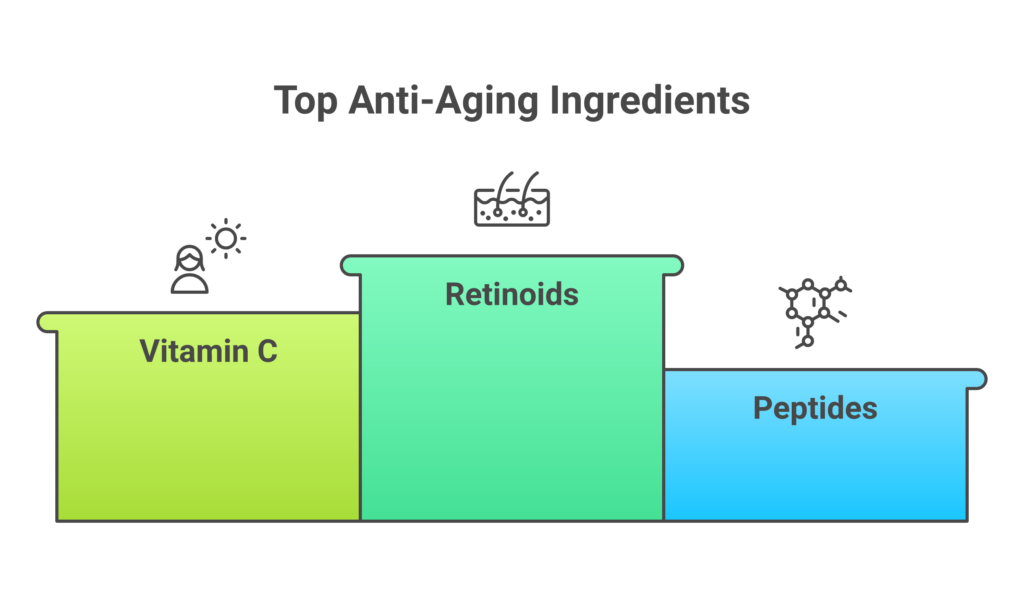
The best anti-wrinkle cream is one you will actually use consistently. Retinoids have the most clinical evidence behind them, followed by vitamin C, peptides, niacinamide, and hyaluronic acid. You do not need to spend $200 on a single product. A well-formulated $25 retinol cream, paired with daily sunscreen, will do more for your skin than any luxury product used inconsistently.
Start with one active ingredient. Build tolerance. Add a second active after 4 to 6 weeks if your skin handles the first one well. And wear sunscreen every single day, rain or shine. That one habit prevents more visible aging than every cream on this list combined.
For personalized product recommendations based on your skin type and concerns, explore our verified wrinkle cream reviews page.
Medical Disclaimer: This article is for informational purposes only and does not constitute medical advice. The information provided here is based on published clinical research but should not replace professional medical consultation. Consult a board-certified dermatologist before starting any new skincare treatment, especially if you are pregnant, breastfeeding, or have a skin condition. Individual results may vary. The products mentioned are not endorsed by Consumer Health Guide as treatments for medical conditions.
Further Reading from Consumer Health Guide
If you want to go deeper, our guide to anti-aging skincare for men covers what most product pages skip. For readers comparing options, see our breakdown of collagen powder buying guide. A useful companion read is treating hyperpigmentation at home.
We also looked closely at eye creams for puffiness in a separate guide. For the related question, check crow’s feet treatments. You can dig into skincare for women over 50 if that overlaps with what you’re researching.
Pair this with best treatments for body age spots for a fuller picture. Our notes on neck wrinkle treatments address an adjacent topic worth knowing. For wider context, see how to remove fine lines.
If symptoms or causes matter to you, our collagen format comparison guide is a good next step. See also: retinol for wrinkles. Related Consumer Health Guide research: collagen 101.