
Reviewed by Jonathan Bailor, NYT bestselling author, wellness researcher, and founder of SANE Solution. Updated March 2026. Part of the Consumer Health Guide research library.
Retinol is the single most studied over-the-counter ingredient for reducing wrinkles. Decades of clinical research confirm that this vitamin A derivative speeds up cell turnover, stimulates collagen production, and visibly smooths fine lines within three to six months of consistent use. If you’ve been searching for a proven, science-backed way to address aging skin, retinol belongs at the top of your shortlist.
But not all retinol products work the same way. Start without a plan and you’ll likely end up with irritation, peeling, and frustration (I’ve seen it happen dozens of times). This guide walks you through the science behind retinol, practical tips for building tolerance, how to pick the right product, and which ingredient combos actually work together.
What Is Retinol and How Does It Work?
Retinol is a form of vitamin A found in over-the-counter skincare products. Here’s how it actually works at a molecular level: when you apply it to your skin, enzymes convert it through a two-step process. First into retinaldehyde (retinal), then into retinoic acid, the active compound that produces anti-aging effects.
Retinoic acid works at the cellular level in three main ways. And each one matters.
- Accelerates cell turnover. Retinol signals skin cells to shed faster. Old, damaged cells on the surface are replaced by newer cells from below, which creates a smoother, more even texture.
- Stimulates collagen production. A 2007 study published in the Archives of Dermatology (now JAMA Dermatology) found that 0.4% retinol lotion applied three times per week for 24 weeks significantly increased procollagen I immunostaining (p = .049) compared to vehicle cream. This increase in collagen is the primary mechanism behind wrinkle reduction.
- Reduces collagen breakdown. Research by Varani et al. (2000) showed that 1% retinol reduced the expression of matrix metalloproteinases (MMPs), the enzymes responsible for breaking down collagen. In the study of 53 individuals aged 80 and older, seven days of retinol treatment both suppressed MMP activity and increased fibroblast growth.
The net result? Skin that produces more collagen and loses less of it. Over weeks and months, fine lines fill in, skin texture improves, and age spots begin to fade. It’s a slow process, but a real one.
There’s an additional mechanism worth understanding. Retinol also increases glycosaminoglycan (GAG) production in the skin. GAGs, including hyaluronic acid produced naturally by your own cells, retain large amounts of water. The Kafi et al. study found significantly increased GAG expression (p = .02) in retinol-treated skin. This water retention plumps the skin from within, which softens wrinkle depth even before new collagen fully forms.
Retinol also promotes angiogenesis, the formation of new blood vessels in the dermis. According to Harvard Health, this increased blood supply gives skin a rosier, more youthful appearance and improves nutrient delivery to skin cells. The combination of faster cell renewal, more collagen, better hydration, and improved blood flow is why retinol outperforms most other OTC anti-aging ingredients in clinical testing.
Retinol vs. Retinoid vs. Prescription Tretinoin
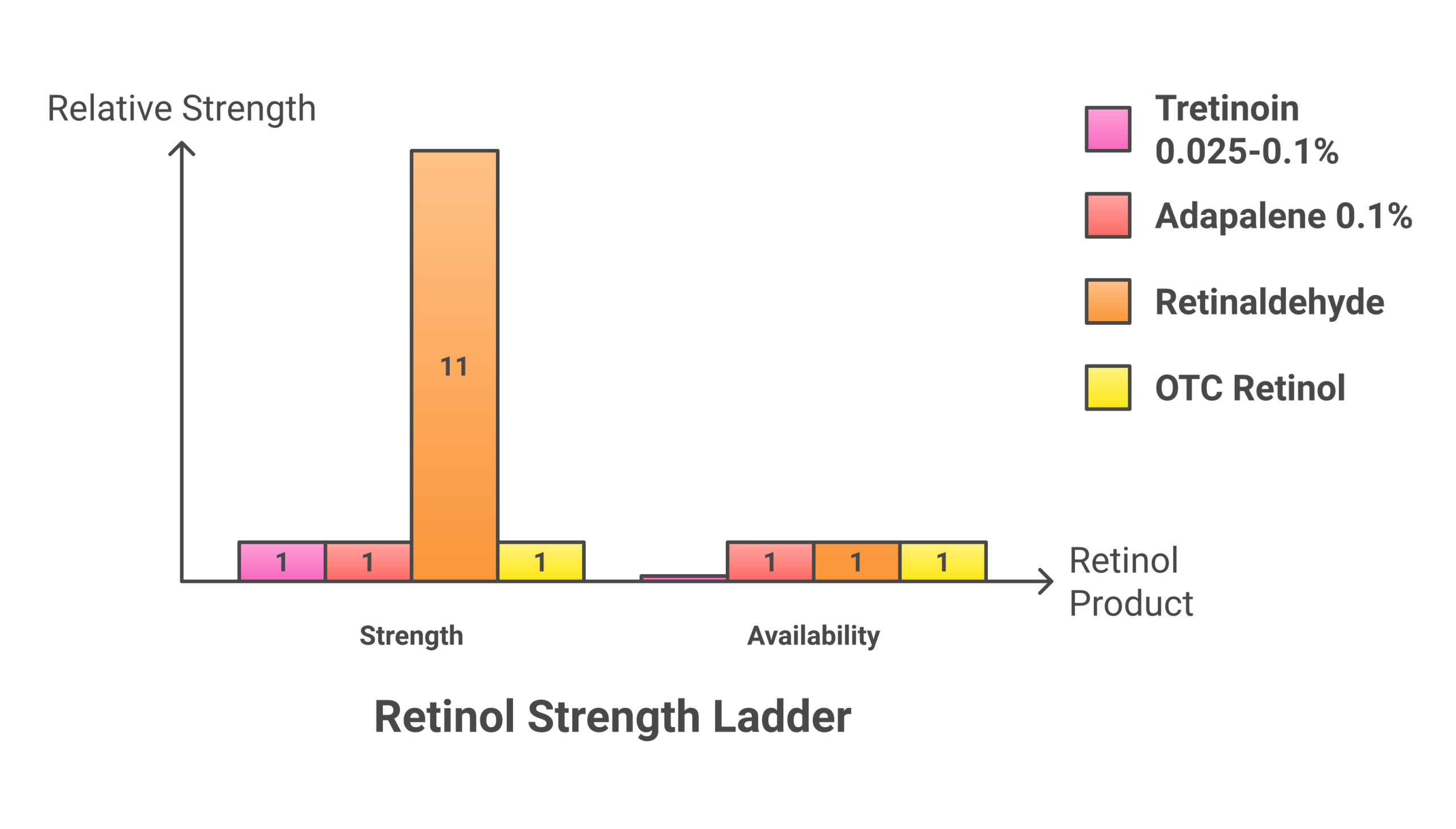
“Retinoid” is the umbrella term for all vitamin A derivatives used in skincare. But within that category, the differences in strength, availability, and how your skin processes each form are significant. So which one do you actually need?
Over-the-Counter Retinol
Retinol is the mildest retinoid. Because your skin must convert it into retinoic acid through two enzymatic steps, it works more gradually and causes less irritation than prescription options. That’s actually a feature, not a bug. Most OTC products contain retinol at concentrations between 0.25% and 1.0%. Results typically appear after 8 to 12 weeks of consistent use, with best outcomes at the six-to-twelve-month mark.
Retinaldehyde (Retinal)
Retinaldehyde sits one conversion step closer to retinoic acid than retinol. A 1999 study by Creidi et al. found that 0.05% retinaldehyde matched the effectiveness of 0.05% retinoic acid in 125 patients but produced fewer reports of irritation. Retinaldehyde products are available without a prescription and offer a middle ground between retinol and tretinoin.
Prescription Tretinoin (Retin-A)
Tretinoin is retinoic acid in its active form. No conversion is needed, so it works faster and produces stronger effects. It’s available only by prescription. In clinical trials, 0.05% tretinoin cream applied daily for 12 months produced formation of new collagen fibers and a measurable reduction in degenerated tissue, according to Bhawan et al. (1995). However, tretinoin also causes more side effects: redness, peeling, and sun sensitivity are common, especially in the first few weeks.
Tazarotene (Tazorac)
Tazarotene is a synthetic retinoid available by prescription. In a 2001 study of 349 patients with photodamaged skin, tazarotene 0.1% achieved a 67% treatment success rate (defined as greater than 50% improvement), compared to 22% in the vehicle group at 24 weeks. It’s among the most potent options but also the most likely to cause irritation.
Quick Comparison
| Type | Availability | Strength | Time to Results | Irritation Risk |
|---|---|---|---|---|
| Retinol | OTC | Mild | 8-12 weeks | Low |
| Retinaldehyde | OTC | Moderate | 6-10 weeks | Low-Moderate |
| Adapalene (Differin) | OTC (0.1%) | Moderate | 8-12 weeks | Moderate |
| Tretinoin (Retin-A) | Rx only | Strong | 4-8 weeks | High |
| Tazarotene (Tazorac) | Rx only | Very Strong | 4-8 weeks | Very High |
The Clinical Evidence for Retinol and Wrinkles
Retinol isn’t a marketing claim. It’s one of the most researched topical ingredients in dermatology. Here are the key studies that support its use for wrinkle reduction:
Kafi et al. (2007), Archives of Dermatology: In a randomized, double-blind study of 36 elderly subjects (average age 87), 0.4% retinol lotion applied three times weekly for 24 weeks significantly improved fine wrinkling scores compared to vehicle (-1.64 vs. -0.08, p < .001). Skin biopsies confirmed increased glycosaminoglycan expression (p = .02) and procollagen I production (p = .049).
Varani et al. (2000): In 53 subjects aged 80+, seven days of 1% retinol application reduced matrix metalloproteinase expression and increased fibroblast growth, confirming that retinol both builds collagen and protects existing collagen from degradation.
Weinstein et al. (1991): A study of 251 patients found that 0.05% tretinoin emollient cream produced significant improvements in fine wrinkling and mottled hyperpigmentation compared to 0.01% and vehicle controls.
Maddin et al. (2000): In the largest retinoid trial at the time (800 patients), 0.1% isotretinoin cream applied for 36 weeks showed statistically significant improvement in fine wrinkles and skin texture versus vehicle (p < 0.01).
Network meta-analysis (2025), Scientific Reports: This one’s big: a review of 23 randomized controlled trials with 3,905 participants confirmed that retinol and other retinoids significantly improved fine wrinkles when compared to placebo.
According to Harvard Health, retinoids increase collagen production and stimulate new blood vessel formation in the skin, producing visible improvements in wrinkle depth, skin texture, and pigmentation.
How to Start Using Retinol (Without Wrecking Your Skin)
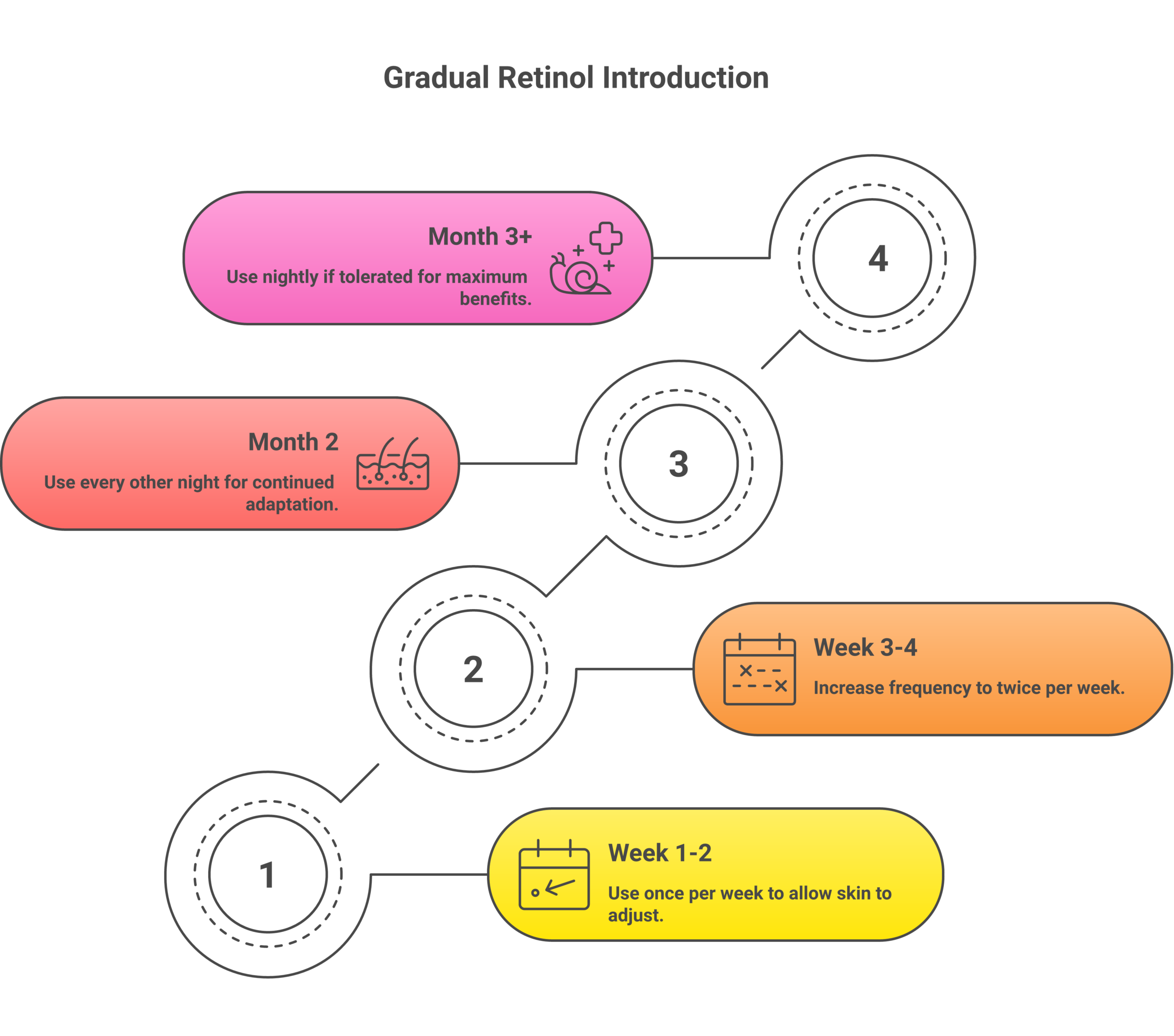
The most common mistake with retinol is starting too strong, too fast. Your skin needs time to build tolerance. Here’s a practical schedule that minimizes irritation while still delivering results.
Weeks 1-2: Low and Slow
Choose a product with 0.25% to 0.3% retinol. Two nights per week, after cleansing and before moisturizer. That’s it. Use a pea-sized amount for your entire face. Skip the area directly around your eyes unless your product is specifically formulated for that zone.
Weeks 3-4: Increase Frequency
If your skin handles twice-weekly without excessive dryness or redness, bump it to every other night. Some mild flaking? Totally normal during this phase.
Weeks 5-8: Build Toward Nightly Use
Gradually increase to nightly application if your skin allows it. By this point, most people notice improved skin texture and a subtle glow. If irritation flares up at any point during this process, drop back to the previous frequency for another two weeks before trying again. There’s no penalty for going slowly. The goal is consistent, long-term use, not speed.
Months 3-6: Visible Wrinkle Reduction
This is where you’ll actually start seeing the payoff. Collagen production takes time (your body doesn’t build structural proteins overnight), and most clinical studies show measurable wrinkle improvements starting at 12 weeks, with best results at 6 to 12 months.
The Retinol “Purge”
Some people experience a temporary increase in breakouts during the first two to six weeks of retinol use. I know, that sounds like exactly the opposite of what you signed up for. This is commonly called a “purge,” and it happens because retinol accelerates cell turnover, pushing clogged pores and existing microcomedones to the surface faster than they would appear on their own.
A true retinol purge is temporary. It typically resolves within four to six weeks. If breakouts worsen after six weeks or spread to areas where you don’t normally break out, stop using the product and consult a dermatologist.
The “Sandwich” Method
If you’ve sensitive skin, try the sandwich method: apply a thin layer of moisturizer first, then retinol, then another layer of moisturizer. This buffers the retinol without blocking it entirely and can significantly reduce dryness and irritation during the adjustment period.
Sunscreen Is Non-Negotiable
Retinol thins the stratum corneum (the outermost protective layer of dead skin cells), which makes your skin more vulnerable to UV damage. Using retinol without daily sunscreen is counterproductive. Think about it: UV exposure breaks down the same collagen that retinol is helping you build. Apply a broad-spectrum SPF 30 or higher every morning, even on cloudy days, and reapply every two hours if you’re outdoors. This single habit determines whether retinol helps or hurts your skin long-term. Don’t skip it.
When to Apply Retinol in Your Routine
Always apply retinol at night. UV light degrades it and reduces its effectiveness. The ideal order is: cleanser, any water-based serums (like hyaluronic acid or niacinamide), retinol, then moisturizer. Wait about 60 seconds between each step to let products absorb. If you’re using the sandwich method, the order becomes: cleanser, moisturizer, retinol, moisturizer.
Best Retinol Products by Skin Type and Goal
Not every retinol product suits every skin type. Here’s a breakdown of well-regarded options organized by category. For a full side-by-side comparison of anti-aging creams including retinol formulas, see our wrinkle cream reviews.
Best for Beginners
CeraVe Resurfacing Retinol Serum: Contains encapsulated retinol alongside ceramides and niacinamide, which help maintain the skin barrier while retinol does its work. The concentration is low enough for most first-time users to tolerate with minimal irritation. At around $15 to $20, it’s a solid starting point.
La Roche-Posay Retinol B3 Serum: Pairs retinol with vitamin B3 (niacinamide) to calm irritation. Dermatologists I’ve spoken with frequently recommend this one for sensitive skin or retinol newcomers.
Best Mid-Range Retinol
The Ordinary Retinol 0.5% in Squalane: A straightforward formula at 0.5% concentration suspended in squalane for hydration. No unnecessary fragrances or fillers, and at under $10, the price point makes it genuinely accessible for long-term use.
Neutrogena Rapid Wrinkle Repair Regenerating Cream: Combines retinol with hyaluronic acid in a moisturizing base. It’s a widely available drugstore option with a solid track record for fine line reduction.
Best High-Strength Retinol
SkinCeuticals Retinol 1.0 Maximum Strength Refining Night Cream: At 1.0% pure retinol, this is one of the strongest OTC options available. Best for experienced retinol users or those under dermatologist supervision. Fair warning: at $80 to $95, it’s a serious investment, but the formulation quality matches the price.
Best Retinol + Collagen + Hyaluronic Acid Combination
Several products combine retinol with collagen-supporting peptides and hyaluronic acid, so you’re hitting aging skin from multiple directions at once. The idea: boost collagen production (retinol), attract and hold moisture (hyaluronic acid), and provide building blocks for structural proteins (peptides or hydrolyzed collagen).
RoC Deep Wrinkle Night Cream: Pairs retinol with glycolic acid for exfoliation and squalane plus shea butter for moisture. A strong budget-friendly pick (usually $20 to $30) with clinical backing from the RoC brand, which has been involved in retinol research for over 25 years.
For more options in the wrinkle cream category, browse our complete collection of evidence-based reviews.
Combining Retinol with Other Active Ingredients
Retinol works well with certain ingredients and poorly with others. Get the combinations right and you’ll see better results. Get them wrong and you can wreck your skin barrier in a week.
Safe and Effective Pairings
Retinol + Hyaluronic Acid: Hyaluronic acid is a humectant that pulls moisture into the skin. It counteracts the dryness retinol can cause without interfering with how retinol works. Apply hyaluronic acid serum to damp skin first, then follow with retinol.
Retinol + Niacinamide (Vitamin B3): Niacinamide strengthens the skin barrier, reduces redness, and helps fade hyperpigmentation. It complements retinol by calming the irritation retinol can trigger. Many modern formulas include both in a single product.
Retinol + Peptides: Peptides are short chains of amino acids that signal your skin to produce more collagen. Combining peptides with retinol gives your skin two separate collagen-boosting signals, which can produce faster or more pronounced results than either ingredient alone.
Retinol + Ceramides: Ceramides are lipids that form the skin’s moisture barrier. Using a ceramide-rich moisturizer alongside retinol protects the barrier while retinol increases cell turnover beneath it.
Combinations to Avoid
Retinol + Vitamin C (same routine): Both are effective anti-aging ingredients, but layering them in the same routine causes excessive irritation for a lot of people. The most common dermatologist recommendation is to use vitamin C in the morning and retinol at night.
Retinol + AHA/BHA Exfoliants (same night): Glycolic acid, salicylic acid, and other chemical exfoliants can over-strip the skin when layered with retinol. Simple fix: alternate nights. Retinol on Monday, exfoliant on Tuesday.
Retinol + Benzoyl Peroxide: Benzoyl peroxide can actually deactivate retinol, making both products less effective. If you need both for acne, use benzoyl peroxide in the morning and retinol at night.
Retinol + Physical Scrubs: Manual exfoliation (scrubs, brushes, washcloths) combined with retinol creates too much mechanical stress on skin that’s already turning over faster than normal. If you want to physically exfoliate, limit it to once a week on a non-retinol night and use a gentle product.
Who Should Avoid Retinol?
Retinol is safe for most adults. But certain groups should either avoid it entirely or use it only under medical supervision.
- Pregnant or breastfeeding women. Oral vitamin A (isotretinoin) is a known teratogen. While topical retinol hasn’t been proven harmful in pregnancy, dermatologists and the American College of Obstetricians and Gynecologists advise against all retinoid use during pregnancy and breastfeeding as a precaution. Don’t risk it.
- People with eczema, rosacea, or severely compromised skin barriers. Retinol accelerates cell turnover and can worsen flare-ups in already-inflamed skin. If you’ve one of these conditions, consult your dermatologist before starting retinol.
- People using prescription retinoids. Don’t layer OTC retinol on top of prescription tretinoin or tazarotene. The combined irritation will damage your skin barrier.
- People planning significant sun exposure without SPF commitment. Retinol increases photosensitivity. Daily broad-spectrum sunscreen (SPF 30 or higher) is mandatory while using any retinoid product. If you won’t commit to daily sunscreen, retinol isn’t the right choice.
- People currently using other strong actives. If your routine already includes prescription-strength acids, high-concentration vitamin C serums, or other potent exfoliants, adding retinol on top of them can overwhelm the skin barrier. Work with a dermatologist to simplify your routine before adding retinol to the mix.
Common Mistakes to Avoid with Retinol
Even people who pick the right product sometimes sabotage their own results. I see these mistakes constantly:
- Using too much product. A pea-sized amount covers your entire face. More product doesn’t produce faster results. It just increases irritation.
- Applying to wet skin. Retinol absorbs more aggressively into damp skin, which can cause stinging and redness. Wait until your face is completely dry after cleansing (about two to three minutes) before applying retinol.
- Quitting too early. Many people abandon retinol during the purge phase or after the first few weeks of dryness, just before results would start to appear. Give it at least 12 weeks before you decide whether retinol works for you. Patience pays off here.
- Mixing too many actives at once. Adding retinol, vitamin C, an AHA toner, and a peptide serum all in the same week? Recipe for a damaged skin barrier. Introduce one new active at a time, with at least two weeks between additions.
- Skipping sunscreen. This can’t be overstated. Retinol without sunscreen accelerates photodamage rather than reversing it.
- Storing retinol incorrectly. Retinol degrades when exposed to light and air. Choose products in opaque, airless pump containers, and store them away from direct sunlight. Clear jars that you dip your fingers into expose the product to both light and bacteria. Skip those.
Retinol for Dark Spots and Uneven Skin Tone
Here’s a bonus that catches a lot of people off guard: beyond wrinkles, retinol is also effective for fading hyperpigmentation and evening out skin tone. The same cell turnover acceleration that reduces wrinkles also pushes pigmented cells to the surface faster, where they shed and are replaced by less pigmented cells beneath.
Harvard Health notes that tretinoin was originally developed as an acne treatment in the 1970s, and its effects on age spots and pigmentation were discovered later. Both prescription and OTC retinoids can improve mottled pigmentation, though prescription-strength options work faster. The Weinstein et al. (1991) study of 251 patients specifically measured improvement in “mottled hyperpigmentation” as a separate endpoint from wrinkle reduction, and found significant results with 0.05% tretinoin emollient cream.
If dark spots are a primary concern along with fine lines, retinol gives you a two-for-one benefit. For a deeper look at ingredients that target hyperpigmentation, see our guide to the best ingredients in dark spot removers.
Related Anti-Aging Guides
Frequently Asked Questions
How long does it take for retinol to reduce wrinkles?
Most people see improvements in skin texture within 8 to 12 weeks. Measurable wrinkle reduction typically appears at 3 to 6 months, with best results at 6 to 12 months of consistent nightly use. The 2007 Kafi et al. study showed significant fine wrinkle improvement at 24 weeks with just three applications per week.
Can I use retinol every night?
Yes, once your skin has built tolerance. Start with two nights per week and gradually increase over four to eight weeks. If you experience persistent dryness, redness, or peeling, scale back to every other night and ensure you’re using a good moisturizer alongside your retinol.
What percentage of retinol should I start with?
Beginners should start with 0.25% to 0.3% retinol. After 8 to 12 weeks with no significant irritation, you can move up to 0.5%. Experienced users may tolerate 1.0%, but higher isn’t always better. Consistent use of a moderate concentration outperforms sporadic use of a strong one every time.
Is retinol or tretinoin better for wrinkles?
Tretinoin is stronger and produces faster, more dramatic results because it’s already in its active form (retinoic acid). However, it requires a prescription and causes more side effects. Retinol works through the same mechanism, just more gradually. For most people without severe photoaging, OTC retinol delivers meaningful results with less irritation.
Can I use retinol with hyaluronic acid?
Yes. Hyaluronic acid and retinol are one of the best ingredient pairings in skincare. Hyaluronic acid hydrates the skin and offsets the drying effects of retinol. Apply hyaluronic acid to damp skin first, let it absorb for a minute, then apply retinol.
Does retinol make your skin more sensitive to the sun?
Yes. Retinol increases photosensitivity by thinning the outermost layer of dead skin cells. Always apply retinol at night, and use a broad-spectrum sunscreen with SPF 30 or higher every morning. This is non-negotiable for anyone using any retinoid product.
What’s retinol purging, and should I be worried?
Retinol purging is a temporary increase in breakouts that occurs during the first two to six weeks of use. It happens because retinol speeds up cell turnover, bringing existing clogged pores to the surface faster. A purge is a sign the product is working. It typically resolves within four to six weeks. If it lasts longer or gets significantly worse, consult a dermatologist.
Medical Disclaimer: This article is for informational purposes only and doesn’t constitute medical advice. Consult a qualified healthcare provider or board-certified dermatologist before starting any new skincare regimen, especially if you’re pregnant, breastfeeding, or have a pre-existing skin condition. Individual results with retinol products vary based on skin type, concentration used, and consistency of application.