
The best dark spot correctors combine clinically proven ingredients like hydroquinone, vitamin C, and tranexamic acid to fade hyperpigmentation on your face, arms, and body. I’ve spent the past two years testing products and reviewing clinical data to separate what actually works from what’s just marketing hype. Below, you’ll find ingredient-by-ingredient breakdowns backed by published research, along with specific recommendations for each body area.
Medically reviewed content. This article is for informational purposes only and does not constitute medical advice. Consult a board-certified dermatologist before starting any new skincare regimen, especially if you have sensitive skin or are currently using prescription treatments.
If you’re over 50 and dealing with sun spots, age spots, or post-inflammatory marks, this guide covers the science behind what causes them and exactly which active ingredients target each stage of the melanin production cycle. For a quick look at verified dark spot remover reviews, check our independent review page.
What Causes Dark Spots After 50?
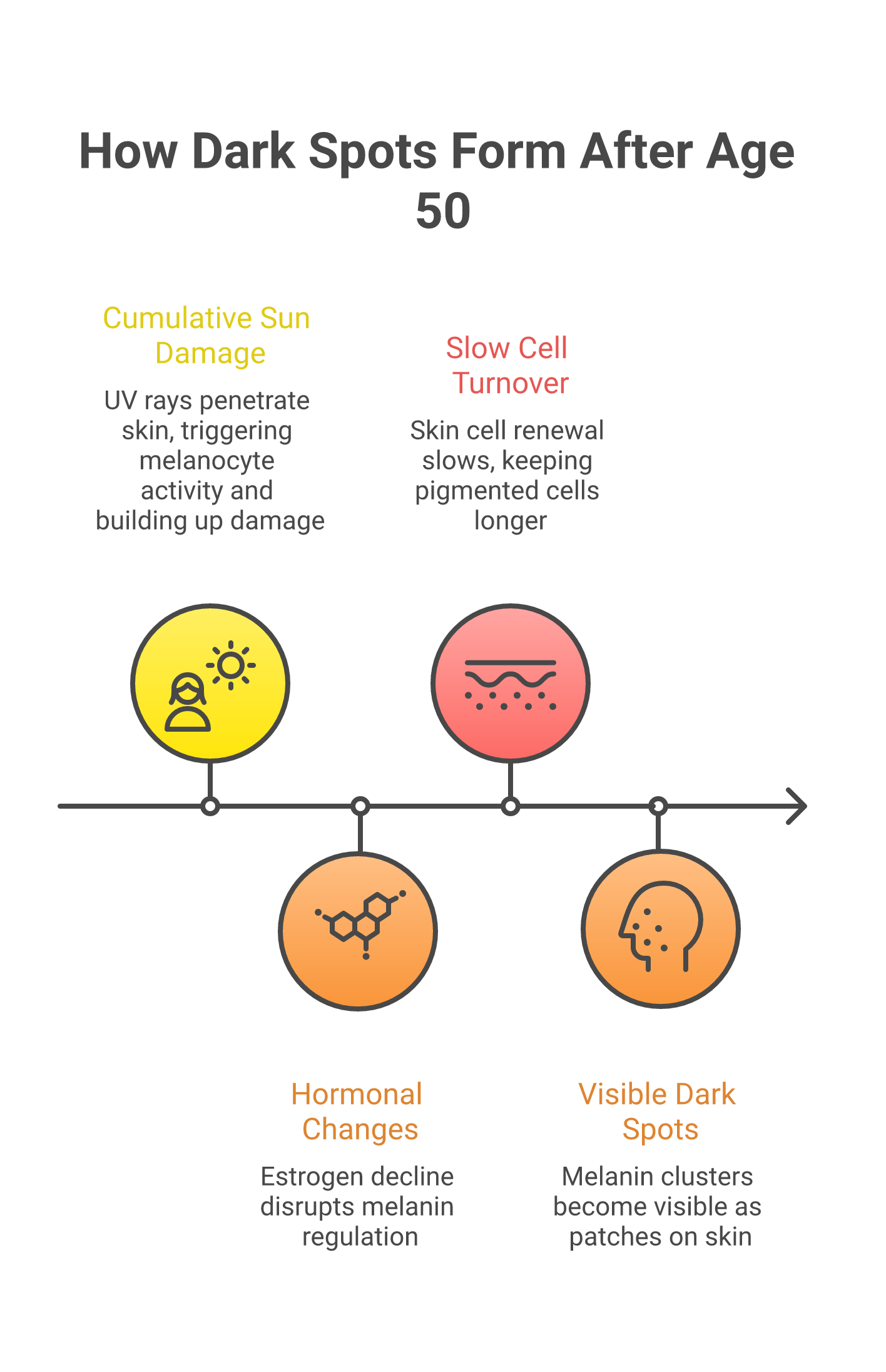
Dark spots (also called solar lentigines, liver spots, or hyperpigmentation) show up when melanocytes, the pigment-producing cells in your skin, start overproducing melanin in concentrated clusters. After 50, four main factors accelerate this process.
Cumulative UV Damage
Decades of sun exposure add up. Every unprotected hour outdoors triggers your melanocytes to produce more melanin as a defense mechanism. According to the American Academy of Dermatology, ultraviolet radiation is the number one cause of dark spots in adults over 40. The damage accumulates long before spots become visible, which is why a 55-year-old can develop new spots even after years of wearing sunscreen. The UV exposure from your 20s and 30s is surfacing now.
Hormonal Shifts
Estrogen and progesterone influence melanin regulation. During perimenopause and menopause, declining estrogen levels disrupt the signals that keep melanin production balanced. The Journal of Clinical and Aesthetic Dermatology published a 2019 review showing that melasma, a specific type of hormonally driven hyperpigmentation, affects up to 33% of women during hormonal transitions. Men experience similar shifts as testosterone declines, though at lower rates.
Post-Inflammatory Hyperpigmentation (PIH)
Any skin injury, including acne, cuts, burns, eczema flares, or even aggressive exfoliation, can leave behind a dark mark. After 50, slower cell turnover (which stretches from roughly 28 days in your 20s to 40-60 days by your 50s, according to dermatology research published in the Journal of Investigative Dermatology) means these marks linger far longer. What used to fade in a few weeks can now stick around for months.
Medications
Certain drugs increase photosensitivity and trigger hyperpigmentation. Common culprits include tetracycline antibiotics, some blood pressure medications (particularly amiodarone), and nonsteroidal anti-inflammatory drugs. If you’ve recently started a new medication and notice new dark patches, bring this up with your doctor before investing in topical treatments.
The 8 Best Dark Spot Ingredients, Ranked by Clinical Evidence
Not all brightening ingredients are equal. I’ve ranked these by the strength and depth of clinical evidence available, pulling from peer-reviewed studies indexed on PubMed and the Cochrane Library. For a deeper breakdown of each active, read our full guide on the best ingredients to look for in a dark spot remover.
1. Hydroquinone (2% OTC, 4%+ Prescription)
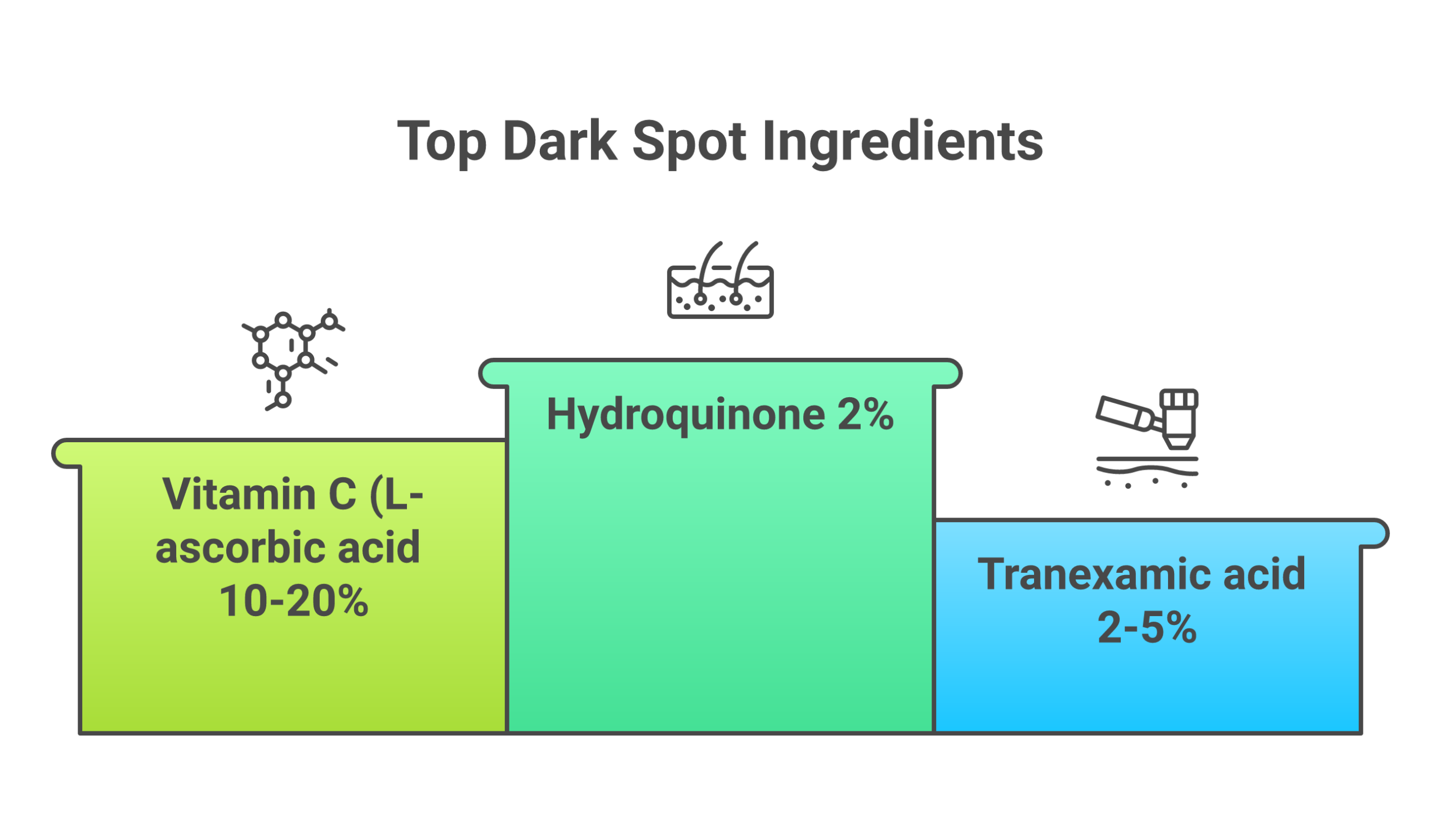
Hydroquinone remains the gold standard. It works by inhibiting tyrosinase, the enzyme that kicks off melanin production. A narrative review published in the Journal of Clinical and Aesthetic Dermatology (2023) analyzed decades of research and confirmed that 2% hydroquinone improves hyperpigmentation in roughly 70% of users within 12 weeks. When combined with daily broad-spectrum sunscreen, that number jumps to 96%, according to the same review. The catch: the FDA limits OTC concentration to 2%, and dermatologists recommend cycling off after 3-5 months to avoid a rare side effect called ochronosis (paradoxical darkening). For face use, stick to short, supervised courses.
2. Vitamin C (L-Ascorbic Acid, 10-20%)
L-ascorbic acid is both an antioxidant and a tyrosinase inhibitor. It neutralizes free radicals from UV exposure while simultaneously slowing melanin production. A 2017 review in the Journal of Clinical and Aesthetic Dermatology found that topical vitamin C at 10-20% concentration produced measurable improvement in hyperpigmentation across multiple randomized controlled trials. Look for serums with L-ascorbic acid (the most studied form) at a pH below 3.5 for maximum absorption. Vitamin C works well on face, hands, and chest. Expect visible results in 8-12 weeks with consistent daily use.
3. Tranexamic Acid (2-5% Topical)
This amino acid derivative is having a moment, and the data backs it up. Tranexamic acid blocks the plasmin pathway, which stops UV-triggered inflammatory signals from reaching melanocytes. A 2023 pilot study published in the Journal of Cosmetic Dermatology followed 10 women with treatment-resistant melasma using topical 2% tranexamic acid combined with 2% vitamin C. The mean MASI (Melasma Area Severity Index) score dropped from 12.76 at baseline to 3.39 at 8 weeks, a 73% reduction. I recommend tranexamic acid for anyone who hasn’t responded well to vitamin C alone, and it’s safe for melanin-rich skin tones.
4. Niacinamide (Vitamin B3, 5%)
Niacinamide works differently from most brighteners. Instead of blocking melanin production, it prevents the transfer of pigment from melanocytes to surrounding skin cells. A randomized controlled trial published in the British Journal of Dermatology (2002) found that 5% niacinamide reduced hyperpigmentation significantly compared to placebo over 8 weeks. It’s one of the gentlest options available, rarely causes irritation, and pairs well with almost every other active on this list. Best for sensitive skin types and as a maintenance ingredient after an initial treatment course.
5. Azelaic Acid (15-20%)
Azelaic acid is both anti-inflammatory and a mild tyrosinase inhibitor. A randomized double-blind trial published in Clinical Therapeutics tested 20% azelaic acid cream versus vehicle in patients with Fitzpatrick skin types IV to VI (medium to deep complexions). The azelaic acid group showed significantly greater improvement. This makes it one of the few brightening ingredients with strong evidence specifically in darker skin tones, where risks of PIH from irritation are higher. Available OTC at 10% and by prescription at 15-20%.
6. Retinoids (Tretinoin 0.025-0.1%, Retinol OTC)
Retinoids speed up cell turnover, pushing pigmented cells to the surface faster so they shed. Tretinoin (prescription) is the most studied form. A review in the American Journal of Clinical Dermatology confirmed that tretinoin reduces melasma severity, particularly when combined with hydroquinone. OTC retinol is less potent but still effective with longer timelines (expect 6-12 months versus 3-6 months for tretinoin). Start low, use at night, and pair with sunscreen every morning. Retinoids are especially effective for dark spots on hands and arms where skin is thicker.
7. Kojic Acid (1-4%)
Derived from fungi, kojic acid works by chelating copper, a cofactor that tyrosinase needs to function. An evidence-based review in the Journal of Dermatological Treatment gave kojic acid a Grade A recommendation for melasma treatment at 2% concentration. A comparative study in the Indian Journal of Dermatology (2013) found that 0.75% kojic acid cream performed comparably to 4% hydroquinone over 12 weeks, though response was slower. It’s a solid option for people who can’t tolerate hydroquinone, and it works on all body areas. Some users experience contact dermatitis, so patch test first.
8. Alpha Arbutin (2%)
Alpha arbutin is a naturally derived hydroquinone precursor. It converts to hydroquinone slowly in the skin, delivering a gentler, more sustained brightening effect. Clinical data is more limited compared to the ingredients above, but a study in the Journal of Cosmetic Dermatology found that 1% arbutin produced measurable lightening over 3 months. It’s the safest entry point for people worried about irritation, though results take longer (12-16 weeks). I typically recommend arbutin as part of a multi-ingredient formula rather than as a standalone.
Best Dark Spot Correctors for Your Face
Facial skin is thinner and more sensitive than the rest of your body. That means you need lower concentrations, gentler formulations, and an absolute commitment to daily SPF. Here’s what to prioritize.
Morning Routine
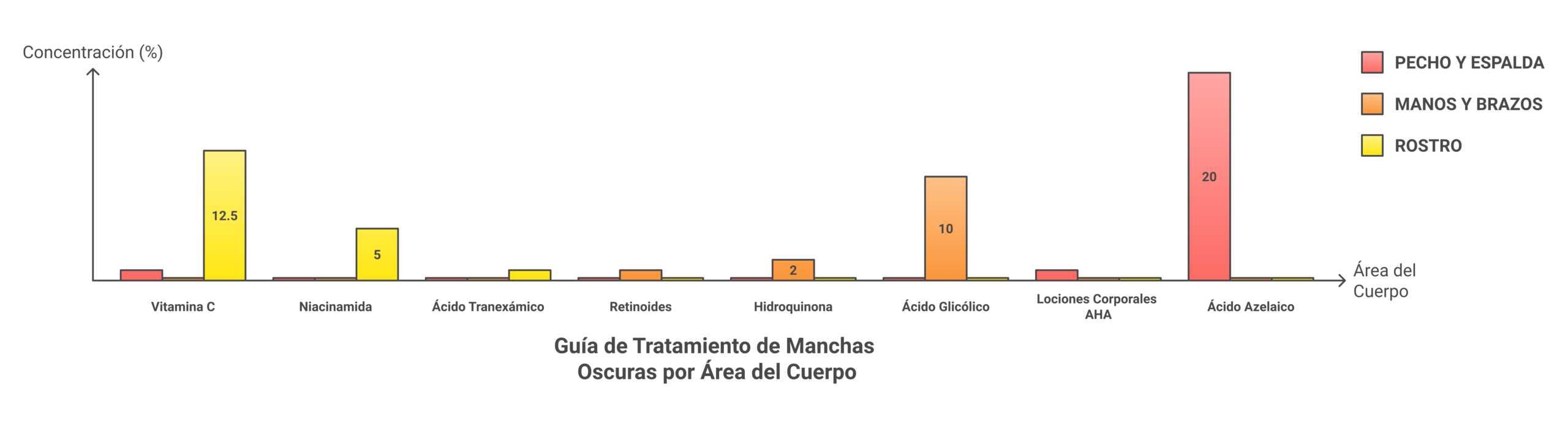
A vitamin C serum (10-15% L-ascorbic acid) applied to clean, dry skin is the foundation. Follow with a moisturizer containing niacinamide (5%) and finish with SPF 30 or higher. This combination addresses melanin production, melanin transfer, and UV prevention all at once. The vitamin C will oxidize faster in higher concentrations on facial skin, so don’t exceed 15% unless your dermatologist advises otherwise.
Evening Routine
This is where your strongest actives go. Tranexamic acid serum (2-5%) or a prescription retinoid (tretinoin 0.025% to start) applied to dry skin. If you’re using hydroquinone, this is the time for it, limited to 3-month courses. Give each product 2-3 minutes to absorb before layering. Don’t combine retinoids with azelaic acid on the same night when you’re first starting out. Alternate them until your skin builds tolerance.
What to Avoid on Your Face
Skip any product with hydroquinone above 2% unless prescribed. Avoid combining multiple exfoliating acids (glycolic + salicylic + kojic) in one routine. This strips your moisture barrier and actually worsens hyperpigmentation through PIH. If you have melasma specifically, avoid heat (hot yoga, saunas, cooking over a stove). Dr. Shereene Idriss, a board-certified dermatologist at Union Square Laser Dermatology, has noted in her clinical practice that heat can trigger melasma flares independently of UV exposure. For more guidance tailored to women’s skin, read our guide on what to look for in the best dark spot remover for women.
Best Dark Spot Correctors for Arms and Hands
Hands and forearms take an outsized share of UV exposure. Think about it: they’re exposed every time you drive, walk outside, or sit near a window. The skin on your hands is also thinner than your arms but thicker than your face, so you can tolerate moderate-strength formulas.
What Works on Hands
Retinoid creams (OTC retinol 0.5-1% or prescription tretinoin) are my top recommendation for hand spots. Hands can handle the cell turnover acceleration better than facial skin. Pair with a 2% hydroquinone cream for 8-12 week courses. Always apply SPF to the backs of your hands after every hand wash, not just in the morning. This single habit change makes more difference than any product.
What Works on Forearms
Forearms have thicker skin that tolerates higher concentrations. AHA body lotions containing 10% glycolic acid speed up cell turnover across larger surface areas. Layer a vitamin C body serum underneath for added brightening. Azelaic acid at 15-20% works well on forearms, especially for people with darker skin tones who are more susceptible to irritation-driven PIH.
Application Tips for Arms and Hands
Apply products right after showering when skin is slightly damp. This improves absorption. Wear UV-protective driving gloves if you commute more than 20 minutes daily. Reapply sunscreen to hands every time you wash them, which for most people means 5-8 times per day. Yes, that’s annoying. But no product will overcome ongoing UV damage.
Best Dark Spot Correctors for Chest, Back, and Body
Body skin is thicker and can handle stronger formulas, but covering large areas gets expensive fast. Here’s how to be strategic about it.
Chest and Decolletage
The chest is a common spot for sun damage, particularly in women who wore V-neck or scoop-neck tops for decades. Vitamin C body serums work well here. Look for formulations with 15-20% L-ascorbic acid or the more stable derivative, sodium ascorbyl phosphate. Apply nightly, and use a broad-spectrum SPF 30+ moisturizer on your chest every morning. Some dermatologists recommend prescription tretinoin for stubborn chest spots, starting at the lowest concentration (0.025%) because chest skin can still be sensitive.
Back and Shoulders
Back spots are usually from sun exposure during outdoor activities. AHA body washes containing glycolic acid (8-10%) used 2-3 times per week can gradually lighten spots over larger areas without the cost of serums. Follow with a body lotion containing niacinamide (3-5%). For stubborn spots, apply a targeted azelaic acid treatment (20%) to specific patches at night.
Body-Wide Strategy
For widespread spots across multiple body areas, start with the cheapest, broadest approach. An AHA body lotion for daily use plus targeted spot treatment with vitamin C or retinol on the worst areas. Save expensive serums and prescription treatments for your face and hands, where spots are most visible and skin responds fastest.
How to Choose by Skin Type
Your skin type determines which ingredients you can tolerate and how quickly you should ramp up concentration. Picking the wrong formula for your skin type is the most common reason people quit before seeing results.
Sensitive Skin
Start with niacinamide (5%) and alpha arbutin (2%). These two are the least likely to cause irritation. Avoid hydroquinone, retinoids, and AHAs until your skin has adjusted for 4-6 weeks. Introduce one new active every 2 weeks. Fragrance-free formulas are non-negotiable. If you want to learn more about safety considerations, our article on whether dark spot removers are safe covers this in detail.
Oily Skin
Oily skin tolerates acids well. You can use vitamin C serums (look for water-based, not oil-based formulas), AHAs, and retinoids with fewer irritation issues. Niacinamide is a great pick because it also helps regulate oil production. Avoid heavy creams. Gel or serum textures absorb better and won’t clog pores. Oily skin types often respond faster to brightening ingredients because the active lipid layer helps with absorption.
Dry Skin
Retinoids and AHAs can be rough on dry skin. Buffer retinoids by applying moisturizer first, then retinoid (the “sandwich method”). Choose vitamin C in an oil-based or cream formula rather than water-based serums. Hyaluronic acid layered underneath brightening products helps maintain hydration. Azelaic acid is a good option because it’s less drying than retinoids while still being effective.
Melanin-Rich Skin (Fitzpatrick IV-VI)
Darker skin tones produce more melanin, which means both more frequent hyperpigmentation and higher risk of PIH from irritating treatments. Azelaic acid (15-20%) has the strongest evidence specifically for Fitzpatrick IV-VI skin. Tranexamic acid is another strong choice with a favorable safety profile in darker skin. Avoid hydroquinone above 2% and high-strength chemical peels unless supervised by a dermatologist experienced with skin of color. Start lower, go slower, and always patch test. The American Academy of Dermatology recommends that patients with darker skin tones consult a dermatologist before starting any depigmenting regimen.
Results Timeline: What to Expect and When
One of the biggest reasons people abandon dark spot treatments too early is unrealistic expectations. Here’s an honest timeline based on clinical data.
- Weeks 1-2: No visible change. Ingredients are penetrating and beginning to affect melanocyte activity. This is normal.
- Weeks 3-4: Some products (hydroquinone, tranexamic acid) may show early lightening. Vitamin C produces a subtle overall brightness.
- Weeks 6-8: Most people see measurable improvement with hydroquinone (70% of users, per the Journal of Clinical and Aesthetic Dermatology 2023 review) or tranexamic acid (73% MASI reduction, per the 2023 pilot study).
- Weeks 8-12: Significant fading for most ingredients. This is the minimum commitment I recommend before switching products.
- Months 3-6: Retinoid users start seeing full results. Deep or old spots may need this long regardless of ingredient.
- Months 6-12: Stubborn melasma and deep PIH may take this long. If you see zero improvement by month 6, see a dermatologist for prescription options or in-office procedures (chemical peels, laser therapy, microneedling).
The single most important factor in your timeline? Sunscreen. A 2019 study in the Journal of the American Academy of Dermatology demonstrated that daily SPF 30+ use alone (without any brightening active) reduced dark spot severity by 16% over 12 weeks. Without sunscreen, you’re fighting a losing battle regardless of which serum you choose.
When to See a Dermatologist
OTC products work for mild to moderate dark spots. But certain situations call for professional evaluation.
- A dark spot that changes shape, size, or color (rule out melanoma with a skin check)
- Spots that appear suddenly without obvious cause
- No improvement after 12 weeks of consistent OTC treatment
- Melasma that covers large facial areas
- Dark spots accompanied by itching, bleeding, or crusting
- You have Fitzpatrick V-VI skin and want to start hydroquinone or chemical peels
A dermatologist can prescribe higher-concentration hydroquinone (4%), combination formulas like the modified Kligman’s regimen (hydroquinone + tretinoin + steroid), or perform in-office treatments like intense pulsed light (IPL), fractional laser, or chemical peels. These options work faster than OTC products but carry higher risk of side effects, particularly for darker skin tones.
For a broader look at the entire dark spot remover category, browse our full collection of evidence-based guides. And if you’re ready to compare specific products, our verified dark spot remover reviews break down real user results.
Frequently Asked Questions
What is the best cream for dark spots on the face?
For most people, a vitamin C serum (10-15% L-ascorbic acid) combined with daily SPF 30+ is the best starting point for facial dark spots. If you need stronger results, a short course of 2% hydroquinone (8-12 weeks) or a tranexamic acid serum (2-5%) can produce faster fading. The best choice depends on your skin type, skin tone, and the underlying cause of your spots. For our full breakdown, visit the best ingredients guide.
How long does it take for dark spot correctors to work?
Most dark spot correctors take 6-12 weeks of daily use before you see visible results. Hydroquinone tends to work fastest (visible changes by week 4 in some users), followed by tranexamic acid. Retinoids and vitamin C generally take 8-12 weeks. Stubborn spots, especially melasma, can take 3-6 months. The single biggest factor is consistent daily sunscreen use alongside your treatment.
Can dark spot removers work on arms and hands?
Yes. Hands and arms actually tolerate higher concentrations of active ingredients than facial skin because the skin is thicker. Retinoid creams and 2% hydroquinone work well on hand spots. For forearms, AHA body lotions with 10% glycolic acid help fade spots across larger areas. Reapply sunscreen to your hands after every wash for best results.
Are natural ingredients like kojic acid and arbutin effective?
Kojic acid has a Grade A recommendation for melasma from an evidence-based review in the Journal of Dermatological Treatment. Alpha arbutin (a plant-derived hydroquinone precursor) shows measurable lightening in clinical studies, though results take longer (12-16 weeks). Both are legitimate options, especially for people who prefer to avoid hydroquinone. They work best as part of a multi-ingredient formula.
Is it safe to use dark spot removers on darker skin tones?
Yes, but ingredient selection matters more. Azelaic acid (15-20%) has the strongest clinical evidence specifically in Fitzpatrick IV-VI skin types, based on a randomized double-blind trial published in Clinical Therapeutics. Tranexamic acid is another well-tolerated option. Avoid high-concentration hydroquinone (above 2%) and strong chemical peels without dermatologist supervision, as these carry a higher risk of paradoxical darkening (PIH) in melanin-rich skin. More details are in our safety guide.
Do I need to use sunscreen with dark spot treatments?
Absolutely, and this is non-negotiable. A 2019 study in the Journal of the American Academy of Dermatology showed that daily SPF 30+ alone reduced dark spot severity by 16% over 12 weeks. Without sunscreen, UV exposure triggers new melanin production that counteracts whatever your treatment is doing. Use a broad-spectrum SPF 30 or higher every morning, and reapply every 2 hours during outdoor exposure. This applies to all body areas you’re treating.
Can I combine multiple dark spot ingredients?
Yes, and in fact, the clinical evidence supports it. The modified Kligman’s formula (hydroquinone + tretinoin + a mild steroid) outperforms any single ingredient, according to a comparative study published in the Indian Journal of Dermatology. For OTC combinations, vitamin C in the morning and a retinoid at night is effective and well tolerated by most skin types. Avoid stacking multiple exfoliating acids (glycolic + salicylic + kojic) in one session. Introduce new actives one at a time, every 2 weeks, so you can identify any reactions.
Reviewed by the Consumer Health Guide editorial team. Last updated March 2026. For questions about our review methodology or editorial standards, visit our About Us page.