
For most healthy adults, probably yes, but with one caveat: we did not find any published study that tested collagen and creatine taken together. What exists is separate research on each one. Creatine has a long safety record in studies of healthy people, and collagen has been well tolerated in skin trials. The two work through different pathways, and no interaction between them has been reported.
The short answer
Collagen is taken mainly for skin and connective tissue. Creatine is taken mainly for muscle energy and strength. Because no study has looked at the combination, the honest answer rests on the evidence for each supplement on its own, plus the fact that they work through different pathways. Some people, including anyone with kidney disease, should check with a doctor first. Both points are covered below.
What collagen and creatine each do
The two are different kinds of supplement.
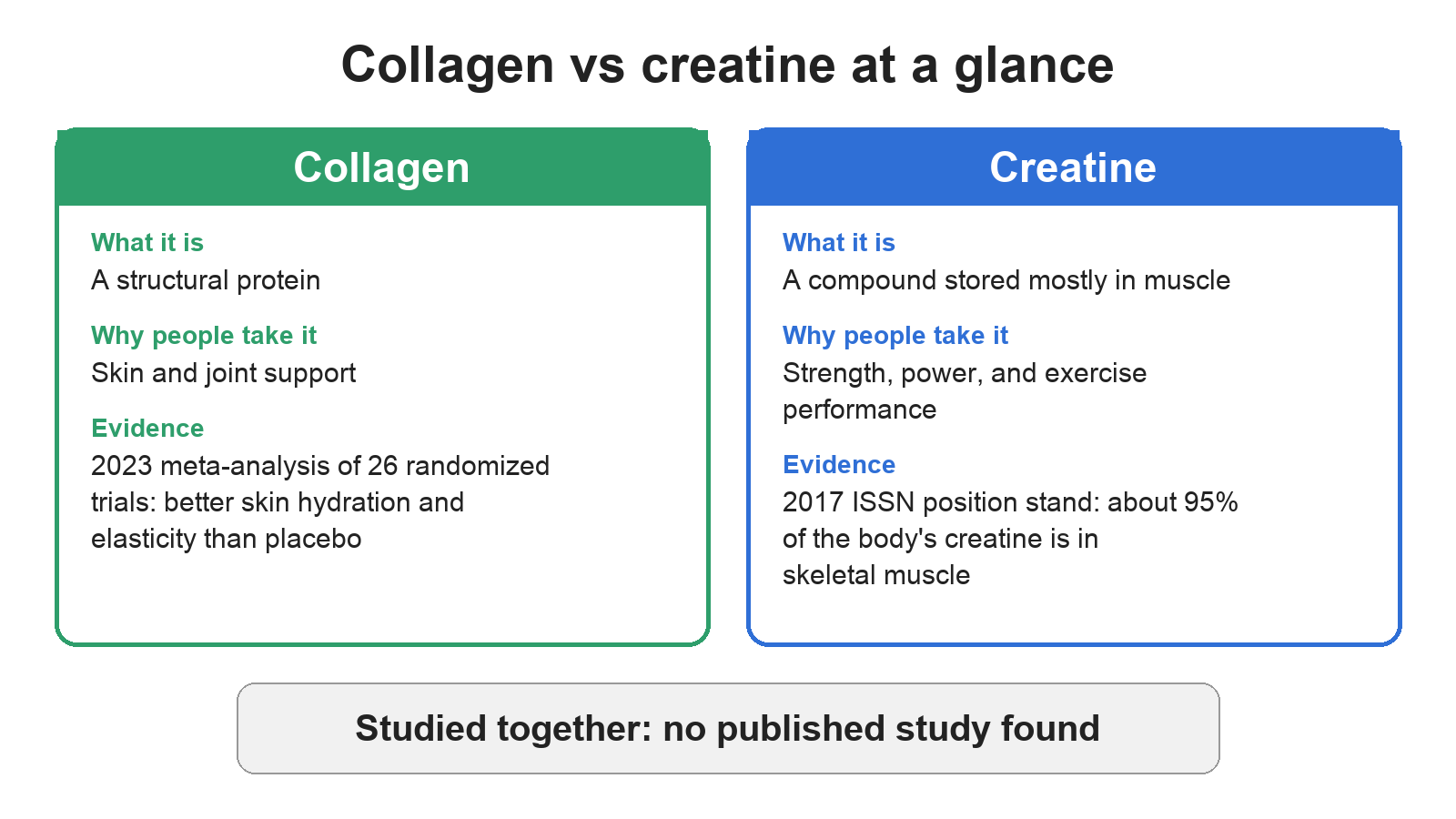
Collagen is a structural protein. Hydrolyzed collagen peptides supply the amino acids the body uses to maintain skin elasticity, joint cushioning, and connective tissue. It is taken mostly for skin and joint support. A 2023 meta-analysis in Nutrients by Pu and colleagues pooled 26 randomized trials (1,721 participants) and found that hydrolyzed collagen improved skin hydration and elasticity compared with placebo. Our guide to how the body makes collagen and the foods that support it covers the basics.
Creatine is not a protein. It is a compound stored mostly in muscle, where it helps regenerate energy for short, intense efforts. According to the 2017 International Society of Sports Nutrition position stand (Kreider and colleagues, Journal of the International Society of Sports Nutrition), about 95% of the body’s creatine is in skeletal muscle, and food sources are mainly red meat and seafood. It is taken for strength, power, and exercise performance. The same position stand calls creatine monohydrate the most extensively studied and clinically effective form of creatine for use in supplements.
Because one is a structural protein and the other is an energy compound, they work through separate pathways, and no interaction between them has been reported. That is not the same as a study showing the combination is safe, since we found none.
| Collagen | Creatine | |
|---|---|---|
| What it is | A structural protein | A compound stored mostly in muscle |
| Why people take it | Skin and joint support | Strength, power, and exercise performance |
| Key evidence | 2023 meta-analysis of 26 randomized trials: better skin hydration and elasticity than placebo | 2017 ISSN position stand: about 95% of the body’s creatine is in skeletal muscle |
| Studied together? | No published study found | |
How to take collagen and creatine together
Combining them is simple, and a few practical points make it easier.
- Same drink or separate. Both are sold as powders that mix into liquids, and collagen also comes in liquid form (our comparison of liquid collagen vs powder covers the trade-offs). No study has shown that timing them together or apart changes anything.
- Amounts used in research. The ISSN position stand describes 3 to 5 grams a day as a maintenance intake of creatine. Collagen studies have used a wide range: a 2019 analysis in Nutrients by Paul and colleagues describes effective amounts in the literature of 2.5 to 15 grams a day. Follow your product labels.
- Timing is flexible. Creatine raises muscle stores gradually with daily intake; the ISSN position stand notes that 3 grams a day for 28 days raises them gradually. Collagen studies used daily intake over weeks. Consistency matters more than the hour you take either one.
- Consistency is the real rule. Pick a moment in your routine you will actually keep.
Does one affect the other’s absorption?
No study has measured this directly. We found no reports that collagen changes how creatine is absorbed or stored, or that creatine changes how the body uses collagen peptides. Collagen is a protein broken down into amino acids and peptides, and creatine is a separate small compound, so there is no known reason to expect interference.
One point worth clearing up: collagen is classed as an incomplete protein because it lacks the essential amino acid tryptophan, as Paul and colleagues explain in their 2019 Nutrients analysis. That is a reason not to rely on collagen as your only protein source, but it has nothing to do with creatine. If you use collagen for skin and joints and want a strength benefit from creatine, you are using each one for its actual purpose.
Who should talk to a doctor first
In studies of healthy people, both supplements have been well tolerated. A few situations call for a conversation with a healthcare provider before starting:
- Kidney disease or reduced kidney function. The ISSN position stand found no compelling evidence that creatine harms kidney function in healthy people, but it advises caution and medical consultation for anyone with pre-existing kidney disease.
- Pregnancy or breastfeeding. Speak with your provider before adding either supplement.
- Existing medical conditions or regular medications. A quick check rules out anything specific to your situation.
According to the ISSN position stand, the only consistently reported side effect of creatine in the research literature is weight gain. The collagen trials in the 2023 meta-analysis did not highlight safety problems, though that review did not analyze adverse events in detail. Choosing third-party-tested products helps you know what you are taking. Our guide to collagen supplement types and what to look for explains the main forms and labels. If you want help picking a collagen formula, see our collagen supplement guides and reviews, and our verified collagen supplement reviews compare specific products.
Frequently asked questions
Can I take collagen and creatine at the same time?
No study has tested them together, and no interaction between them has been reported. They work through different pathways, so you can take them in the same drink or at different times, whichever fits your routine. If you have a medical condition, ask your doctor first.
Should I take collagen and creatine before or after a workout?
No study shows that workout timing matters for this combination. Creatine raises muscle stores gradually with daily intake, and collagen studies used daily intake over weeks, so take them whenever you will be consistent.
Can collagen replace protein powder if I take creatine?
Not fully. Collagen is classed as an incomplete protein because it lacks tryptophan, so it should not be your only protein source. Creatine is separate and does not change that.
Will taking both cause weight gain?
Creatine can. The ISSN position stand says weight gain is the only consistently reported side effect of creatine supplementation. We did not find evidence that collagen causes weight gain.
Is it safe to take collagen and creatine every day?
Each one has been studied with daily use. Creatine studies in healthy people have not shown adverse health effects at studied doses, and collagen has been well tolerated in skin trials. No study has tested daily use of the two together. If you have a kidney condition, are pregnant or nursing, or manage a medical condition, check with your healthcare provider first.
Written by the Editorial Team. This content is for informational purposes and is not medical advice. Speak with your healthcare provider before starting any new supplement. Medically reviewed by Matthew Olesiak, MD, on September 24, 2026.